The Heart Question Hanging Over Xylitol
New research links high blood levels of xylitol to cardiovascular events, with a demonstrated platelet mechanism behind it. The evidence has moved beyond association — but hasn't reached proof of harm.
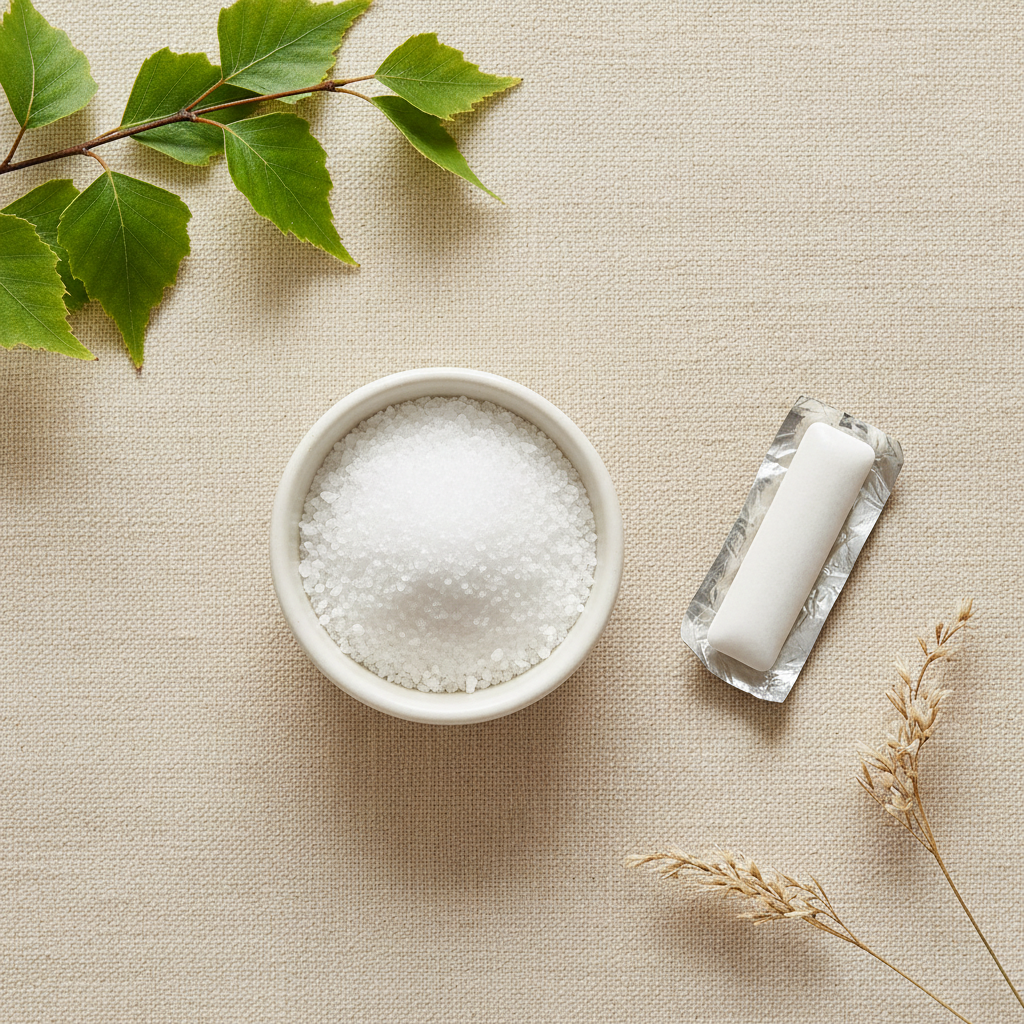
Xylitol sits in chewing gum, sugar-free sweets, some baked goods and dental products, and is widely sold as a lower-calorie, lower-glycaemic alternative to sugar. That has made it particularly attractive in products aimed at people reducing sugar, managing weight or watching blood glucose.
New research raises an awkward question: could high exposure have cardiovascular effects of its own?
TL;DR
- Xylitol is a sugar alcohol, used as a low-calorie sweetener and widely positioned as a healthier alternative to sugar.
- A 2024 Cleveland Clinic study identified xylitol as a cardiovascular-risk marker in a 1,157-person discovery cohort, then found a 57% higher adjusted three-year risk of major cardiovascular events in the highest versus lowest xylitol tertile in an independent 2,149-person validation cohort.
- That study went further than association. Xylitol enhanced platelet reactivity and thrombus formation in experimental work.
- In ten healthy volunteers, drinking a xylitol-sweetened beverage sharply raised plasma levels and increased multiple measures of platelet responsiveness in every participant.
- Research presented at the ESC Congress in August 2026 extended the finding to broader populations — 17,710 people across two cohorts, with 57% higher risk in one and 18% in the other.
- The 2026 findings are conference evidence and haven't completed peer review, so those figures remain provisional.
- The studies measure circulating xylitol, not habitual dietary intake. No dietary dose at which risk begins has been established.
- The evidence has moved beyond a statistical association. It hasn't reached proof of cardiovascular harm.
What Xylitol Actually Is
Xylitol is a sugar alcohol — a class of compounds that includes erythritol, sorbitol and maltitol. It occurs naturally in small quantities in fruit and vegetables, and the human body produces small amounts internally.
That last point is more complicated than it first appears, in two directions. The body's own production runs at levels more than a thousand times lower than those observed after consuming xylitol as a sugar substitute — so "it's natural, your body makes it" is true and largely beside the point when it comes to dietary exposure. But endogenous production also means that a high fasting blood level isn't automatically a marker of who eats the most xylitol. More on that below, because it matters.

Want to Dive Deeper?
Our comprehensive wellness guides provide step-by-step protocols and actionable strategies for lasting health transformation.
Explore GuidesCommercially, xylitol is sometimes sold as "birch sugar." It's roughly as sweet as sucrose with around 40% fewer calories, doesn't raise blood glucose significantly, and has genuine dental benefits — which is why it appears in toothpaste and gum.
The 2024 Study: An Association, Then a Mechanism
The work that started this came from a team led by Dr Stanley Hazen at the Cleveland Clinic, published in the European Heart Journal in 2024. Hazen's group had previously published similar findings on erythritol.
They began with metabolomic analysis of fasting plasma from a discovery cohort of 1,157 patients undergoing cardiac evaluation, which identified xylitol as a candidate risk marker. They then tested it prospectively in an independent validation cohort of 2,149. There, people in the highest tertile of blood xylitol had a 57% higher adjusted risk (hazard ratio 1.57, 95% CI 1.12–2.21) of a major adverse cardiovascular event over three years than those in the lowest.
An association in cardiac patients is interesting but limited. What makes this study unusual is what came next.
The mechanistic work. The team showed experimentally that xylitol enhanced multiple measures of platelet reactivity and thrombus formation. Platelets are the blood cells responsible for clotting. Greater platelet reactivity can increase thrombotic potential, which is relevant to heart attack and ischaemic stroke.
The interventional work. Ten healthy volunteers drank a xylitol-sweetened beverage. Circulating xylitol rose markedly, and multiple measures of platelet responsiveness increased in every participant.
That's a stronger evidence structure than most nutrition epidemiology: an association, a proposed mechanism, and a demonstration that consuming the substance produces acute changes in that mechanism in humans.
The 2026 Study: Beyond Cardiac Patients
The obvious limitation of the 2024 work was the population — people already undergoing cardiac evaluation, not the general public.
Research presented at the European Society of Cardiology Congress in Munich in August 2026, led by Dr Marco Witkowski of the Charité University Hospital in Berlin, addressed that. The team examined circulating xylitol in 17,710 people across two general-population cohorts: the Canadian Longitudinal Study on Aging (CLSA), with six years of follow-up, and EPIC-Norfolk, with thirty.
The direction held. Comparing highest to lowest circulating xylitol, after adjustment for age, sex, smoking status and diabetes, risk of major adverse cardiovascular events was 57% higher in CLSA and 18% higher in EPIC-Norfolk.
That gap between cohorts is worth noting rather than averaging away. It may reflect differences in population, follow-up period or cohort assembly, and it means any single headline percentage oversimplifies.
Until the full paper is published, details of the methods, models and subgroup analyses can't be scrutinised to the same degree as the 2024 European Heart Journal study.
The Caveats, Stated Plainly
The 2026 findings are conference evidence. Presented at ESC Congress rather than published in a peer-reviewed journal, which means the figures could change. That isn't grounds for dismissal given the sample size, but it is grounds for treating the numbers as provisional.
Blood levels are not dietary intake. This is the most important limitation, and the one most coverage skips. The observational studies measured fasting circulating xylitol. Because the body produces xylitol endogenously, high fasting levels may partly reflect individual metabolism rather than how much sugar-free gum someone chews. The human intervention shows that dietary xylitol can sharply raise plasma levels — it doesn't establish that diet explains why some people had chronically higher fasting concentrations.
Ten volunteers can show an acute effect, not a chronic outcome. The interventional study demonstrated that drinking xylitol acutely changes platelet measures. It cannot tell us whether regularly eating xylitol causes heart attacks or strokes.
No dose threshold has been established. The studies don't identify a dietary intake at which cardiovascular risk begins. Swallowed xylitol produces far higher circulating concentrations than endogenous production, but there are no prospective trials showing how different levels of habitual intake translate into cardiovascular events.
Who This Is Actually About
Sugar alcohols occupy an awkward position in dietary advice.
Current guidance is more measured than the marketing suggests. The American Diabetes Association recommends water over both sweetened and non-nutritively sweetened beverages, while allowing non-nutritive sweeteners as a moderate, short-term substitute where that reduces calories and carbohydrate. Its nutrition consensus notes there is little research on benefits specifically from sugar alcohols. Older ADA material discussed xylitol more directly as a lower-glycaemic alternative, which helps explain how these products came to be positioned as they are.
So it would be wrong to say modern diabetes guidance recommends xylitol. What's true is that xylitol is marketed heavily to people managing blood glucose and weight, and those people are, on average, already at elevated cardiovascular risk.
Hazen's own framing of the 2024 findings is direct: the studies suggest xylitol "will likely confer heightened thrombosis potential in the same vulnerable patients that it is marketed towards and intended to protect." If further research bears that out, the problem is as much about product positioning as about the compound.
What This Doesn't Mean
Toothpaste isn't the concern raised by these studies. It's primarily a topical exposure and isn't intended to be swallowed. Xylitol-containing foods, sweets, drinks and heavily consumed gum involve ingestion and aren't equivalent exposures — xylitol in gum is released, swallowed in saliva and absorbed, and heavy use can deliver meaningful quantities.
It isn't an argument for returning to sugar. The case against high sugar intake hasn't weakened. What the research complicates is the assumption that sugar alcohols are a straightforwardly safe substitute.
It isn't a class verdict. The similar findings reported for erythritol raise a broader question about some sugar alcohols, but there isn't evidence to assume every polyol has the same cardiovascular effects.
It isn't settled. Both research teams call for further safety studies, which is the appropriate conclusion from where the evidence sits. The 2024 authors concluded that further cardiovascular safety studies are warranted — not that xylitol had been established as a hazard.
What This Actually Means
The evidence has moved beyond a statistical association, and hasn't reached proof of harm. That's an uncomfortable middle position, but it's where things genuinely are.
If xylitol makes up a substantial part of your sugar substitution, the new evidence is worth knowing about — particularly if you already have cardiovascular or metabolic risk factors. There isn't yet enough evidence to prescribe a specific intake limit, but neither is there enough to assume high habitual intake is cardiovascularly neutral.
Check labels if it matters to you. Xylitol appears in sugar-free confectionery, some peanut butters, protein and "keto" products, baked goods and drinks, often without prominence.

Fresh Start Bundle
Reset your body and mind with our most popular bundle. Includes Sleep Reset, Caffeine Reset, Junk Food Reset, Stress Reset, and Sugar Reset guides.
Get BundleWhat's still missing is the part readers most want. Whether eating xylitol causes cardiovascular events, how much would matter, and whether reducing intake reduces risk. None of those questions has been answered yet.
Frequently Asked Questions
Is xylitol bad for your heart?
Research links high circulating xylitol with an increased risk of major cardiovascular events, and mechanistic work suggests it increases platelet reactivity. The evidence is stronger than most dietary associations because it includes a demonstrated mechanism and a human interventional study, but it doesn't establish that eating xylitol causes cardiovascular events.
How much does xylitol increase cardiovascular risk?
Estimates vary. A 2024 study in patients undergoing cardiac evaluation found a 57% higher adjusted three-year risk in the highest versus lowest tertile of blood levels. Research presented in 2026 across two general-population cohorts found 57% higher risk in one and 18% in the other.
How does xylitol affect the blood?
Experimental work found xylitol enhanced platelet reactivity and thrombus formation. In a small interventional study, drinking a xylitol-sweetened beverage raised plasma levels and increased measures of platelet responsiveness in all ten participants.
Should I stop using xylitol toothpaste?
These studies don't raise that concern. Toothpaste is primarily a topical exposure and isn't intended to be swallowed. Products that are eaten or drunk are a different matter.
Is there a safe amount of xylitol?
No dietary threshold has been established. The research measured circulating blood levels rather than habitual intake, and no prospective trials have shown how different levels of consumption translate into cardiovascular events.
Is xylitol worse than sugar?
That's not what the research shows, and it isn't the right comparison. The findings complicate the assumption that xylitol is a safe substitute for sugar — they don't establish that returning to sugar would be better.
What about erythritol and other sugar alcohols?
The same research group published similar findings on erythritol before the xylitol work. That raises a broader question about some sugar alcohols, but there isn't evidence that every polyol shares the same effects.
Are these findings peer-reviewed?
The 2024 Cleveland Clinic study was published in the European Heart Journal. The 2026 general-population research was presented at the ESC Congress and had not completed peer review at the time of writing.
The Bottom Line
Most nutrition scares rest on an association and a plausible story. This one has more behind it: observational findings in cardiac patients, replication across two much larger population cohorts, platelet experiments, and a small human study showing that drinking xylitol produces acute changes in platelet responsiveness.
It still isn't proof. The 2026 findings await peer review. Fasting blood levels may partly reflect individual metabolism rather than diet. Ten volunteers can demonstrate an acute biological effect, not a chronic outcome. And nobody has established how much dietary xylitol, over how long, would matter.
What makes it worth attention is the positioning. Xylitol is sold as a healthier substitute for sugar, including in products aimed at people watching their weight or blood glucose. We now have enough evidence to question the assumption that high exposure is cardiovascularly neutral — but not enough to conclude that eating xylitol causes heart attacks or strokes.
The next question isn't whether xylitol can affect platelets. It can. It's whether the amounts people actually consume change cardiovascular outcomes over time. That study still needs to be done.
This is general information rather than medical advice. If you're managing diabetes or cardiovascular risk and use sugar-free products regularly, speak to your GP or a registered dietitian rather than making changes on your own.
Related reading: Artificial Sweeteners and Cognitive Decline: What the Study Actually Found · Why Cutting Out All Sugar Can Backfire on Your Gut Microbiome · Why You Crave Something Sweet After a Big Meal
Tags
Further Reading
Found this helpful?
Share this article and help others discover valuable health insights!
Click to share via social media or copy the link
Fresh Start Bundle
Reset your body and mind with our most popular bundle. Includes Sleep Reset, Caffeine Reset, Junk Food Reset, Stress Reset, and Sugar Reset guides.
Get Bundle
Complete Wellness Guides
Discover our library of evidence-based health guides designed to optimize your wellness journey.
Browse Guides