Blog · Lifestyle & Wellness
What Are Flavanols, and How Do You Get More?
By Vitae Team ·
There is now a formal daily target for flavanols, and new research suggests fewer than one in five of us hit it — including people dutifully eating five a day. The problem isn't quantity. It's which foods you pick.
There is now a formal daily target for flavanols, and new research suggests fewer than one in five of us hit it — including people dutifully eating five a day. The problem isn't quantity. It's which foods you pick.
Flavanols occupy an odd position in nutrition. They aren't vitamins, you can't be deficient in them in the classical sense, and until recently no one had put a number on how much you should eat. That has changed, and the gap between the recommendation and what people actually consume is considerable.
TL;DR
- Flavanols (properly, flavan-3-ols) are plant compounds — a subclass of flavonoids, themselves a subclass of polyphenols. Found in tea, cocoa, apples, berries, plums, grapes and some beans.
- There's now a formal target. The Academy of Nutrition and Dietetics reviewed 157 controlled trials and 15 cohort studies and recommended 400–600mg per day, from food rather than supplements.
- Fewer than one in five people reach it. Research published in June 2026 found most people fall well short even when following standard healthy-eating advice such as the NHS Eatwell Guide.
- The mechanistic evidence is good. Meta-analyses support improvements in blood pressure, cholesterol, blood sugar, inflammation and blood-vessel function.
- The outcome evidence is more mixed than reported. COSMOS00352-9/fulltext) — 21,442 people, randomised, placebo-controlled — found a 10% reduction in total cardiovascular events that was not statistically significant. It did find a significant reduction in cardiovascular death.
- Green tea is by far the most efficient source at roughly 320mg per cup. Two and a half cups gets you to 500mg.
- Dark chocolate is a much worse source than its reputation suggests — three squares of 80% cocoa provides only around 20mg.
- Variety beats volume. You'd need roughly 15 cups of raspberries to hit 500mg from one food. Combining sources is the only practical route.
What Flavanols Actually Are
The naming is a mess, so it's worth untangling.
Polyphenols is the broad family of plant compounds that includes most of what gets called "antioxidants" in food marketing. Within that sit flavonoids. Within flavonoids sit flavan-3-ols, commonly shortened to flavanols — and these are the ones with the strongest evidence base.
They occur naturally in plants as monomers such as epicatechin and catechin, and as larger linked molecules called procyanidins. Different plants carry different combinations, which is part of why the amounts vary so wildly between foods that all get described as "rich in antioxidants."
They are not essential nutrients. You will not develop a deficiency disease without them, in the way you would without vitamin C. They belong to a newer category — bioactive compounds that aren't required for survival but appear to influence health meaningfully at habitual intakes.
That distinction is why there was never a recommended intake until recently. Dietary guidelines were built around preventing deficiencies, and flavanols don't fit that model.
The First Real Recommendation
In a notable shift, the Academy of Nutrition and Dietetics00298-5/fulltext) issued the first clinical guideline and intake recommendation for flavan-3-ols, based on a review of 157 controlled trials and 15 cohort studies.
The conclusion: 400 to 600mg per day, specifically from food sources rather than supplements, to reduce cardiovascular disease risk.
The evidence behind it is reasonably consistent. Across those trials, people consuming more flavanols showed lower blood pressure, lower blood sugar, better lipid profiles, lower C-reactive protein — a marker of inflammation — and improved flow-mediated dilation, which measures how readily blood vessels relax. Meta-analyses also support effects on arterial stiffness and insulin resistance.
That's a coherent cluster of cardiometabolic improvements, and it's why the guideline exists.
The Trial That Gets Misquoted
The largest test of flavanols is COSMOS — the Cocoa Supplement and Multivitamin Outcomes Study. It deserves careful handling, because how it's reported and what it found are not the same thing.
The design was strong: 21,442 participants (women aged 65+, men 60+), randomised, double-blind, placebo-controlled, taking 500mg of cocoa flavanols daily, with a median 3.6 years of follow-up. This is the best evidence available.
The primary outcome was negative. Total cardiovascular events fell by 10% in the flavanol group, and that result was not statistically significant.
There were meaningful secondary findings — notably a significant reduction in cardiovascular death, with a hazard ratio of 0.73. And per-protocol analyses, which exclude participants who didn't take their pills as directed, produced the striking numbers that circulate widely: a 15% reduction in total cardiovascular events, 24% in major events, 39% in cardiovascular death.
Those per-protocol figures are the ones you'll see quoted. They should be treated with more caution than they usually are, because excluding non-adherent participants breaks the randomisation that makes a trial trustworthy in the first place. They're informative; they aren't the primary result.
One further piece of context: the supplements were donated by Mars Edge, part of Mars Incorporated, and the most enthusiastic presentation of those secondary figures appears on Mars's own research site. The trial was investigator-initiated and run by reputable researchers at Harvard-affiliated institutions, so this isn't a reason to dismiss it. It is a reason to prefer the primary outcome over the flattering subgroup analysis.
The investigators' own summary is the most useful line in the whole story: eat a balanced diet rich in natural food sources of flavanols, and treat supplements as unproven.
The Finding That Should Change What You Buy
Here's the genuinely new part, published in June 2026.
A large international study found that fewer than one in five people consume enough flavanols — and crucially, that most people fall well short even when following standard healthy eating recommendations such as the NHS Eatwell Guide.
Five portions of fruit and vegetables a day does not reliably get you there. The reason is that flavanol content varies enormously between foods that are nutritionally similar in other respects. A banana and a plum both count as a portion. One is a good flavanol source and the other essentially isn't.
As the researchers put it, the specific choices matter far more than the total amount. This is unusual advice in nutrition, where the standard message is quite reasonably "eat more plants, don't overthink which ones." For flavanols specifically, which ones is the whole question.
Where They Actually Are
The numbers are lopsided enough to be genuinely useful.
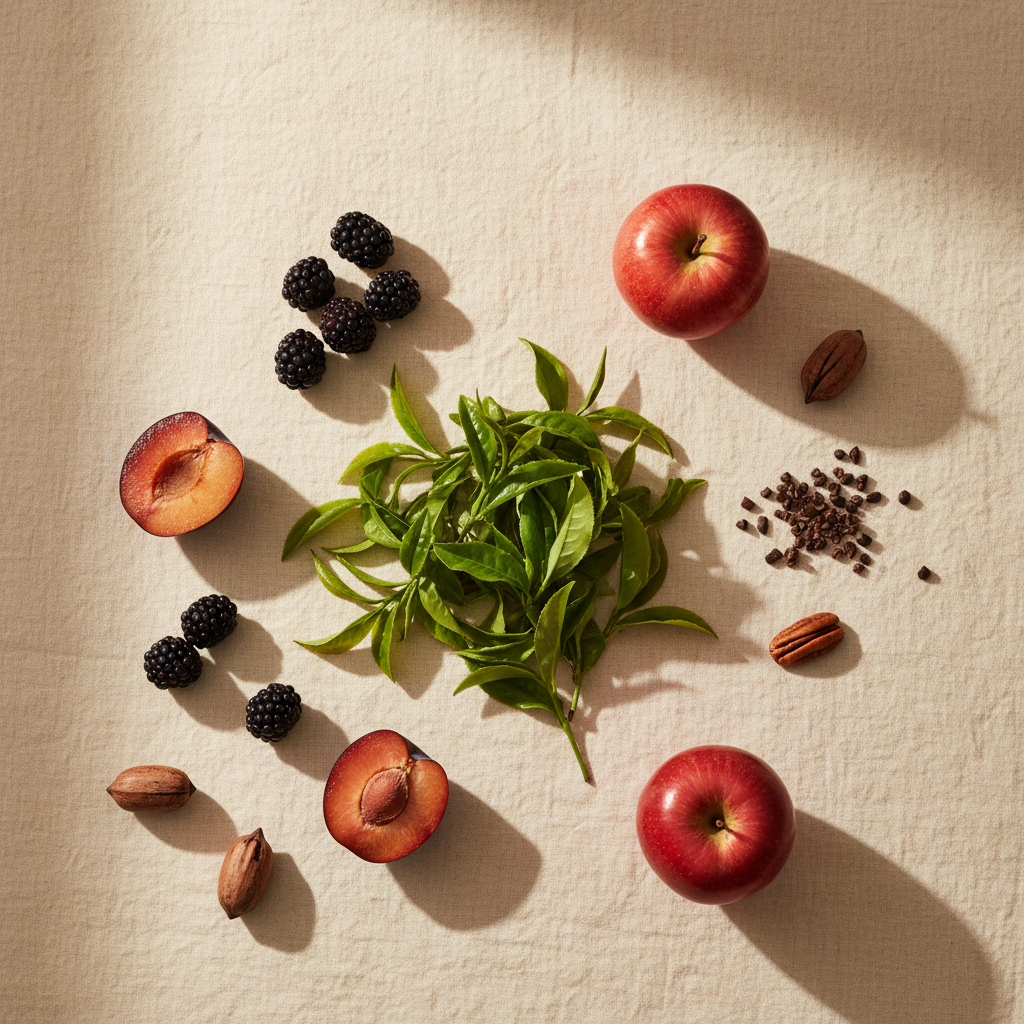
Green tea — around 320mg per 8oz cup. By a wide margin the most efficient source available. Roughly two and a half cups covers the 500mg used in COSMOS. Black tea also contributes substantially and is the single largest source in the average British and American diet, simply through volume consumed.
Plums — around 450mg per 500g punnet. One of the richest fruit sources per serving.
Cranberries — around 300mg per 250g.
Blackberries — around 65mg per cup. Berries generally are good, and blackberries better than most.
Apples — around 15mg for a small one. Modest per fruit, but they're a leading dietary source in practice because people eat them regularly. Pears are comparable.
Broad beans, fava beans and millet (sorghum) are unexpectedly strong contributors — just under a cup of millet approaches the daily target on its own.
Pecans and other nuts contribute meaningfully.
Dark chocolate — around 20mg for three squares of 80% cocoa. This is the number that surprises people. Chocolate has been the poster food for flavanols for two decades, and per realistic serving it's a poor source. The COSMOS supplement delivered 500mg; you would need an implausible amount of chocolate to match it, at considerable cost in sugar and fat. Worse, most commercial chocolate is Dutch-processed (alkalised) for a smoother taste, which destroys much of the flavanol content — so the actual figure for a given bar may be lower still.
Red wine contains flavanols, and this is where the honest caveat matters: the harms of alcohol comfortably outweigh any flavanol benefit, and no serious researcher recommends drinking for the polyphenols.
How to Actually Hit the Target
The practical lesson from the content figures is that no single food gets you there sensibly. You'd need around 15 cups of raspberries to reach 500mg from raspberries alone. Combination is the only realistic route.
Workable daily combinations:
The easiest by some distance: two to three cups of green tea. That's it — the target is met before you've eaten anything.
A food-based version: two apples, a portion of pecans and a large portion of strawberries reaches roughly 500mg.
A realistic mixed day: a cup of tea with breakfast, a handful of blackberries or a plum, an apple in the afternoon, and beans or lentils with dinner.
The most sustainable approach, as one preventive cardiology dietitian put it, is not to chase every flavanol-rich food but to pick one or two you actually enjoy and make them habitual — berries on breakfast several times a week, or swapping a sugary drink for tea.
And a proportion point worth keeping: many people don't yet manage basic fruit and vegetable intake. If that's the situation, overall produce intake is the priority, and flavanol optimisation is a refinement to make afterwards rather than a first move.
Frequently Asked Questions
What are flavanols? Flavanols — properly flavan-3-ols — are plant compounds within the flavonoid family, itself part of the broader polyphenol group. They occur as monomers such as epicatechin and catechin and as larger linked molecules called procyanidins. They aren't essential nutrients, so you can't be deficient in the classical sense, but higher habitual intakes are associated with better cardiovascular and metabolic markers.
How many flavanols should I eat a day? The Academy of Nutrition and Dietetics recommends 400–600mg per day from food, based on a review of 157 controlled trials and 15 cohort studies. Research from June 2026 found fewer than one in five people reach this, including many who follow standard healthy eating guidance such as the NHS Eatwell Guide.
What foods are highest in flavanols? Green tea is the most efficient source at roughly 320mg per cup. Plums provide around 450mg per 500g punnet, cranberries around 300mg per 250g, and blackberries around 65mg per cup. Black tea, apples, pears, broad beans, millet and pecans all contribute meaningfully. Dark chocolate is far weaker than its reputation — around 20mg for three squares of 80% cocoa.
Isn't dark chocolate supposed to be full of flavanols? Cocoa is flavanol-rich as a raw material, but the amount in a realistic serving of chocolate is modest — roughly 20mg for three squares of 80% cocoa, against a 400–600mg target. Most commercial chocolate is also alkalised (Dutch-processed) for flavour, which destroys much of the flavanol content. Enjoy it, but don't count on it for flavanols.
Do flavanol supplements work? The evidence is weaker than the marketing. In COSMOS — the largest trial, with 21,442 participants — the primary outcome of total cardiovascular events fell 10%, which was not statistically significant, though cardiovascular death was significantly reduced. The Academy of Nutrition and Dietetics recommendation specifies food sources, not supplements, and the COSMOS investigators themselves advised eating natural food sources while further outcomes are evaluated.
Won't five-a-day cover it? Apparently not. The June 2026 research found most people fall well short of the flavanol target even when following standard guidance, because content varies enormously between foods that count equally as portions. A banana and a plum are both a portion; only one is a meaningful flavanol source. For this specific compound, which foods you choose matters more than how many.
Can I get enough from one food? Not practically. You'd need roughly 15 cups of raspberries to reach 500mg from raspberries alone. Green tea is the exception — two and a half cups gets you there. Otherwise, combining sources across the day is the only realistic approach.
Does red wine count? It contains flavanols, but the health harms of alcohol outweigh any benefit, and no credible researcher recommends drinking for polyphenols. Grapes, tea and berries deliver the same compounds without the alcohol.
The Bottom Line
Flavanols are a rare case where the science has moved ahead of the dietary guidelines. The mechanistic evidence is solid — blood pressure, lipids, blood sugar, inflammation and vascular function all shift in the right direction. There's now a formal 400–600mg daily recommendation built on more than 170 studies. And the largest trial, while its primary outcome missed significance, found a real reduction in cardiovascular death.
What's genuinely new, and genuinely useful, is the finding that ordinary healthy eating doesn't get most people there. This isn't a nutrient you acquire by eating more plants in general. It's one where a cup of green tea outperforms a punnet of most fruit, where dark chocolate is a decorative source rather than a serious one, and where two apples and a handful of pecans do more than a virtuous but badly chosen salad.
The practical version is unusually simple, which makes a change. Drink tea. Eat berries, plums and apples rather than defaulting to bananas. Keep beans and nuts in the rotation.
And stop relying on the chocolate. It was never doing what you hoped.
This is general information rather than medical advice. If you have a cardiovascular condition or take medication, speak to your GP or a registered dietitian before making significant dietary changes.
If you want a structured way to build these habits into your week, our Reset guides library — paired with the Vitae Companion — turns evidence like this into a practical daily routine.