The Palace of the Grand Master: Rhodes's Fortress That Isn't Quite What It Claims

Experience — Palace of the Grand Master

By James B. Stoney, Editor ·

A 14th-century Knights' fortress, ruined by earthquake, rebuilt by Mussolini's architects in the 1930s as a romanticised version of itself. Here's the real story.
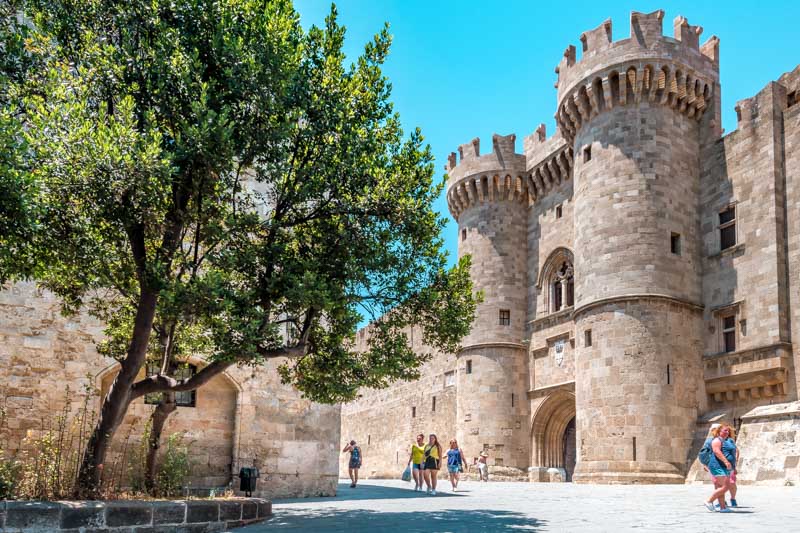
The Palace of the Grand Master, Rhodes Old Town — the fortress gatehouse and twin towers rising above stone walls, with a tree in the foreground
Image: Palace of the Grand Master, Rhodes

A 14th-century Knights' fortress that fell into ruin, then was rebuilt in the 1930s as a rather more theatrical version of itself.

Most medieval castles are honest about their damage. Missing towers, crumbled walls, the visible wear of eight centuries left as evidence.

The Palace of the Grand Master tells a stranger story, because the building most visitors walk through isn't quite the one the Knights lived in.

A Different Premise

The site's history genuinely runs deep. A Byzantine citadel stood here from the 7th century, on the highest point of what is now Rhodes Old Town. When the Knights Hospitaller took control of Rhodes in 1309, they built the palace over it — the administrative centre and residence of the Order's Grand Master, and the seat of power for two centuries of Knights.

In 1481, an earthquake devastated the building. It sat substantially ruined for over four hundred years, through Ottoman rule from 1522, until Italy took control of Rhodes in 1912 and found what remained largely derelict.

What visitors walk through today is the Italian reconstruction of the 1930s.

Illuminated Gothic ruins in Rhodes Old Town at dusk — three arched stone facades lit warmly against a deep blue evening sky
Image: Rhodes Old Town, Greece

The Reconstruction, Honestly

This is the part worth understanding before you go, because it changes what you're looking at.

Mussolini commissioned the architect Vittorio Mesturino to rebuild the palace — not as a strict archaeological restoration, but as a grand, romanticised statement, reportedly intended in part as a potential holiday residence for the Italian king or Mussolini himself. The result is undeniably impressive: soaring Gothic halls, towers, arched corridors, all built to evoke the age of the Knights rather than to precisely reconstruct it.

The mosaic floors, one of the interior's most striking features, are genuinely ancient — but they weren't originally here. They were brought from early Christian and Byzantine buildings excavated on Kos and installed into the rebuilt palace by the Italians, alongside medieval furniture, columns and artwork assembled to complete the effect.

So what you're seeing is a real medieval site, carrying real medieval and Byzantine artefacts, inside a building that is substantially a 20th-century vision of what a Knights' palace should look like. That doesn't make it fake. It makes it a monument to two different periods rather than one — the Hospitaller Knights and Fascist Italy's idea of them.

Interior of the Palace of the Grand Master — a vast stone hall with marble floors, columns, chandeliers and a timber-beamed ceiling
Image: Palace of the Grand Master, Rhodes

What's Actually Inside

The palace occupies two floors and rises 40 metres, an unmissable presence at the top of the Old Town.

The ground floor houses two permanent exhibitions: one tracing the city of Rhodes from its founding in 408 BC through to the Ottoman conquest of 1522, the other presenting archaeological finds from the Medieval Town itself — pottery, sculpture, detached murals. The first floor is where the reconstruction shows most clearly: grand apartments furnished with antiques, the imported mosaics, sculpture and period furniture arranged to suggest a lived-in Grand Master's residence.

Most visits run 70 to 100 minutes — enough to take in both floors without rushing, though the exhibitions reward more time if the history genuinely interests you.

Wider Context

The Old Town around the palace is itself a UNESCO World Heritage Site, and the Street of the Knights leading up to the palace — lined with the medieval inns that housed knights from different regions of Europe — is one of the best-preserved stretches of its kind in Europe.

Combined tickets covering the palace, the nearby archaeological museum and art gallery are consistently the better-value route, and most Old Town walking tours build in a stop here as the natural high point of the visit. Family visits are straightforward: admission is free for anyone under 25, and the content — Crusades, chivalric orders, sieges — tends to land well with children from around Year 5 upward.

View of the Palace of the Grand Master from Mandraki harbour at sunset — the fortress on the hilltop above yachts and waterfront trees
Image: Mandraki harbour, Rhodes

Why It Earns Its Place

Because it's honest, once you know to look for it, about being two things at once: a genuine seat of medieval power, and a 1930s fantasy of what that power should look like.

That combination is more interesting than either a fully authentic ruin or a straightforward reconstruction would be alone. You get the real weight of eight centuries of history, and a second, stranger layer — the story of how a fascist regime chose to stage that history for itself. Few sites in Europe let you read both stories at once, in the same rooms.

For anyone planning a slower Greek-island trip built around long walks through Old Town, late dinners and unhurried mornings, the Reset Series guides and the Reset Companion are a useful pairing for the sleep, digestion and recovery that come with the heat, the walking and the wine.

Related reading: Gundari — Folegandros's First Five-Star Resort · Drakos Taverna — The View Matters More Than the Menu · The Wallace Collection — The Museum Hiding in Plain Sight

Vitae Lifestyle Scorecard

  • Historical significance9.4 / 10
  • Architecture & setting9.5 / 10
  • Visitor experience9.0 / 10
  • Overall experience9.1 / 10
Overall9.25 / 10

Who it's for

  • Anyone visiting Rhodes Old Town — this is the natural anchor point for a half-day walking route.
  • History enthusiasts interested in both the Knights Hospitaller and the more unusual story of the Italian reconstruction.
  • Families — free entry under 25, and content that suits school-age children studying the Crusades.

Questions

Is the Palace of the Grand Master original or rebuilt?

Both. The site has stood since a 7th-century Byzantine citadel, and the Knights Hospitaller built the palace here from 1309. But the building visitors see today is substantially a 1930s Italian reconstruction, commissioned under Mussolini, after the original was devastated by a 1481 earthquake and left in ruin for centuries.

Are the mosaics inside original to the palace?

The mosaic floors are genuinely ancient, but they weren't originally part of this building — they were brought from early Christian and Byzantine sites on the island of Kos and installed during the Italian reconstruction of the 1930s.

How long does a visit take?

Most visitors spend between 70 and 100 minutes covering both floors, including the two ground-floor exhibitions on the history of Rhodes and the first-floor apartments with their mosaics and period furniture.

Is it worth combining with other sites?

Yes — combined tickets covering the palace, the nearby archaeological museum and art gallery offer better value, and the Street of the Knights leading to the palace is worth walking regardless of whether you go inside.

Is it suitable for children?

Yes. Entry is free for anyone under 25, and the content is generally recommended from around Year 5, since UK schools cover the Crusades at that stage. Most families find a visit engaging rather than dry.

Why was the palace rebuilt under Mussolini?

Italy took control of Rhodes in 1912 and found the palace, ruined since the 1481 earthquake, in a state of significant decay. The architect Vittorio Mesturino was commissioned to rebuild it as a grand statement piece, reportedly intended partly as a potential residence for the Italian king or Mussolini, rather than as a precise historical restoration.