Plant Milk Comparison 2026: Oat vs Soy vs Almond vs Pea vs Coconut
Oat, soy, almond, pea, rice, coconut and dairy — what's actually in each, how they compare on protein and calcium, and which one is right for you.
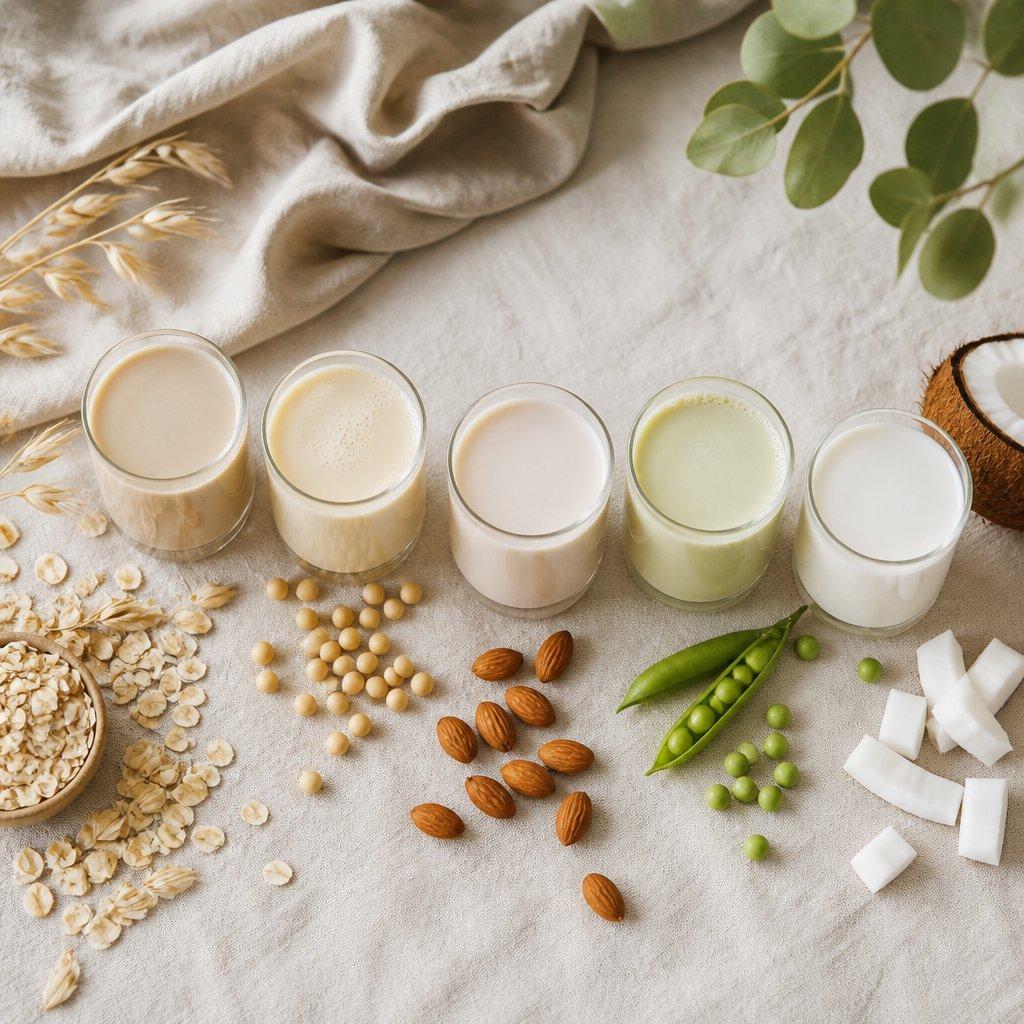
Plant milk has gone from niche substitute to supermarket-shelf staple in under a decade, and the choice has expanded well past oat and almond. Soy, pea, rice and coconut all sit in the same fridge case now, each with a genuinely different nutritional profile, and the differences matter more than the marketing suggests. Here's what each one actually contains, how they compare, and which is right for you.
TL;DR
- Soy milk and pea milk are the closest nutritional matches to dairy, each delivering 7–9g of protein per cup, close to dairy's 8–10g. Soy protein is also "complete," containing all essential amino acids.
- Oat milk delivers meaningfully less protein (3–4g per cup) but more fibre than most alternatives, and is the most common coffee-shop choice for its froth and mild flavour.
- Almond, rice and standard coconut milk are the weakest on protein — generally under 1–2g per cup, nutritionally closer to flavoured water than to milk on this measure.
- Fortification, not the base ingredient, is what makes most plant milks comparable to dairy on calcium, vitamin D and B12. Unfortified and "clean label" versions fall well short.
- "Coconut milk" now covers three different products: tinned (for cooking), standard carton drink (thin, high in saturated fat), and newer barista-style blends with added legume protein for coffee.
- A newer trend runs the opposite direction: some brands have stripped formulations back to 2–3 ingredients — water, the base grain or nut, and salt — specifically to respond to ultra-processed food concerns, at the cost of fortification and barista performance.
What Plant Milk Actually Is
Plant milk is a broad category covering any milk-like drink made by blending a plant source — a grain, a nut, a legume, or a fruit — with water, then straining out the solids. What varies enormously between types isn't the basic method, but the source material itself, which determines how much protein, fat and fibre survives the process, and what has to be added back through fortification to make the final product nutritionally comparable to dairy.
Unlike dairy, which naturally delivers a fairly consistent nutritional profile regardless of brand, plant milk nutrition varies dramatically both between types and between brands of the same type — meaning the label matters considerably more than the category name on the front of the carton. Our complete guide to dairy and plant milks works through each option in full detail.

Want to Dive Deeper?
Our comprehensive wellness guides provide step-by-step protocols and actionable strategies for lasting health transformation.
Explore GuidesThe Options: What Each One Actually Is
Dairy Milk
The benchmark every plant milk gets measured against. One cup of whole dairy milk provides roughly 8–10g of complete protein, around 300mg of naturally occurring, efficiently absorbed calcium, and meaningful amounts of vitamin D, B12, and other minerals including phosphorus and zinc. No single plant milk matches this full profile without added fortification.
Oat Milk
Made from oats blended with water and strained. Per cup (unsweetened): roughly 79–100 calories, 3–4g protein, 1.5g fat, 14g carbohydrate, and nearly 2g fibre — more fibre than most alternatives. Naturally free of dairy, soy and nuts. Standard formulations are typically fortified with calcium, vitamin D and riboflavin. "Barista" versions often contain added oil to improve foaming, which raises the calorie count.
Soy Milk
Made from soybeans. Per cup (unsweetened): roughly 80–100 calories, 7–9g protein, 4–5g fat, 4–5g carbohydrate. Soy protein is complete, containing all essential amino acids — a claim almost no other plant milk can make. Naturally rich in potassium and iron. One caveat: soy contains phytates, which can reduce how efficiently the body absorbs the added, fortified calcium.
Almond Milk
Made by blending almonds with water and straining. Per cup (unsweetened): roughly 39 calories and just 1g protein — the lowest-calorie option here by a wide margin, but nutritionally thin without fortification. Many commercial versions are heavily diluted, sometimes containing only 2% actual almonds, so their nutritional value depends almost entirely on what's added back.
Pea Milk
Made from yellow split pea protein isolate rather than whole peas. Per cup: roughly 7–8g protein, close to matching soy and dairy, with a naturally creamy texture. Typically fortified with vitamin D, calcium and potassium. Its main advantage is allergen profile — it avoids dairy, nuts and soy simultaneously, useful for anyone managing multiple sensitivities without sacrificing protein.
Rice Milk
Made from milled rice and water. The mildest-tasting and most hypoallergenic option, but the weakest nutritionally — typically under 1g protein per cup and the highest in natural sugar and carbohydrate of the group. Its genuine use case is narrow: for anyone allergic to dairy, soy, nuts and peas simultaneously, it may be one of the few remaining options.
Coconut Milk
Now covers three distinct products. Tinned coconut milk is thick and made for cooking. Standard carton coconut milk drink is thin, roughly 45 calories and under 1g protein per cup, with most of its calories from saturated fat (primarily lauric acid) — UK guidance suggests treating it as an occasional choice rather than a daily dairy replacement. A newer category, barista-style coconut blends, adds legume protein such as fava bean to compete with oat and almond in coffee — the protein boost comes from what's added, not from coconut itself.
How They Compare: The Key Data
(Per 1 cup / 240ml, unsweetened, standard fortified formulation unless noted)
| Dairy | Oat | Soy | Almond | Pea | Rice | Coconut (drink) | |
|---|---|---|---|---|---|---|---|
| Calories | ~150 | ~80–100 | ~80–100 | ~39 | ~70–90 | ~110–130 | ~45 |
| Protein | 8–10g | 3–4g | 7–9g | ~1g | 7–8g | <1g | <1g |
| Complete protein | Yes | No | Yes | No | No | No | No |
| Calcium (fortified) | ~300mg (natural) | ~300mg | ~300mg* | ~300mg | ~300mg | ~300mg | ~300mg |
| Saturated fat | Moderate–high | Low | Low | Very low | Very low | Very low | High |
| Lactose | Yes | No | No | No | No | No | No |
| Major allergen | Dairy | Gluten risk** | Soy | Tree nut | None common | None common | None common |
*Soy's naturally occurring phytates can reduce calcium absorption efficiency compared to other fortified milks.
**Oats are naturally gluten-free but often cross-contaminated; check for certified gluten-free labelling if this matters.
Why the Protein Gap Matters More Than It Looks
A 3–8g difference in protein per cup sounds small until you account for how milk is actually consumed. Someone having two coffees a day with oat milk gets roughly 6–8g of protein from that alone; the same two coffees with almond milk deliver closer to 2g. Over a week, that gap becomes the equivalent of a full extra portion of protein-rich food, simply from a drink most people don't think of as a protein source at all.
This matters most for anyone using plant milk as a genuine daily dairy replacement rather than an occasional addition — children, older adults, and anyone with higher protein needs from training or recovering from illness are the groups most affected by choosing a low-protein option without realising the trade-off. It's worth reading alongside the emerging evidence on whether eating less protein could actually slow ageing, which asks the same question from the opposite direction.
Why People Actually Choose Plant Milk Over Dairy
The rise of plant milk isn't primarily about taste or trend. Globally, an estimated 65–70% of adults have reduced lactase activity after infancy — the enzyme needed to digest lactose. The UK is a genuine outlier here: only around 5–10% of white British adults are lactose intolerant, but that figure rises to as high as 75% among non-white British adults, reflecting the evolutionary history of dairy farming concentrated in Northern Europe.
It's worth being precise about the distinction between lactose intolerance and milk allergy, since the two are frequently confused. Intolerance is a digestive issue — uncomfortable, never dangerous, and highly variable between individuals. Allergy is an immune reaction to milk proteins, considerably rarer (around 1–2% of UK adults), and can be severe. Our full guide covers this distinction, and the evidence behind it, in more depth, and the British Dietetic Association sets out the clinical difference clearly.
The Clean Label Trend
Running alongside the push toward higher-protein, more fortified plant milks is a genuinely opposite trend: some brands have stripped formulations back to as few ingredients as possible, in direct response to consumer concern about ultra-processed food.
A small number of ranges now contain just three ingredients — water, the base grain or nut, and a pinch of salt, with no oils, gums or added fortification. The trade-off is real: these versions typically perform worse in coffee and lack the calcium, vitamin D and B12 that make standard fortified plant milks nutritionally closer to dairy. Neither approach is objectively better — they solve different problems, and the right choice depends on whether ingredient simplicity or nutritional completeness matters more for how you're using it.
Frequently Asked Questions
Which plant milk is closest to dairy nutritionally?
Soy milk is the closest overall match, delivering 7–9g of protein per cup — comparable to dairy's 8–10g — and, uniquely among plant milks, a complete amino acid profile. Pea milk is a close second on protein, useful for anyone avoiding soy specifically. Neither matches dairy's naturally efficient calcium absorption without fortification.
Which plant milk has the most protein?

Fresh Start Bundle
Reset your body and mind with our most popular bundle. Includes Sleep Reset, Caffeine Reset, Junk Food Reset, Stress Reset, and Sugar Reset guides.
Get BundleSoy and pea milk lead the category at 7–9g and 7–8g per cup respectively. Oat milk delivers meaningfully less, at 3–4g per cup. Almond, rice and standard coconut milk contain the least protein of the common options, generally under 1–2g per cup.
Is oat milk healthier than almond milk?
It depends what you're optimising for. Oat milk has more protein, more fibre and more carbohydrate than almond milk. Almond milk is lower in calories and sugar but contributes almost no protein. Neither is straightforwardly healthier — oat milk suits anyone prioritising fibre and fullness, almond milk suits anyone prioritising a low-calorie option.
Is coconut milk good or bad for you?
Standard carton coconut milk drink isn't inherently unhealthy, but its calories come overwhelmingly from saturated fat and it provides essentially no protein, so UK health guidance suggests treating it as an occasional choice rather than an everyday dairy substitute. Newer barista-style coconut blends with added legume protein have a meaningfully different nutritional profile and should be checked individually against the label.
Do I need to buy fortified plant milk?
Generally yes, if you're using plant milk as a genuine daily substitute for dairy rather than an occasional addition. Most plant milks naturally lack meaningful calcium, vitamin D, B12 and iodine, and fortification is what closes that gap. Organic and "clean label" three-ingredient versions are often not fortified, which is worth checking rather than assuming.
What's the best plant milk for coffee?
Oat milk remains the most popular choice for its mild flavour and reliable foam, particularly in "barista" formulations that include added oil for texture. Newer barista-style coconut blends with added legume protein are a growing alternative. Three-ingredient "clean label" plant milks generally perform worse in coffee, since the oils and stabilisers that aid frothing have been removed.
The Bottom Line
There is no single best plant milk — only the best plant milk for what you're actually using it for. Soy and pea milk lead on protein and overall nutritional completeness. Oat milk leads on fibre, flavour and coffee performance. Almond and rice milk lead on low calories and broad allergen tolerance, at the cost of nearly all their protein. Coconut milk has split into genuinely different products depending on formulation, and checking the label now matters more than trusting the name on the front of the carton.
Whichever you choose, the two things worth checking before anything else are protein content and fortification status — the two measures where plant milks vary most, and where the gap to dairy is easiest to close or easiest to miss entirely.
If switching milk is part of a wider attempt to settle your digestion, The Gut Reset sets out a structured, evidence-informed place to start.
This is general information rather than medical advice. Anyone with a suspected milk allergy, or removing dairy entirely from a child's diet, should speak to a GP or registered dietitian first.
Related reading
Tags
Further Reading
Found this helpful?
Share this article and help others discover valuable health insights!
Click to share via social media or copy the link
Fresh Start Bundle
Reset your body and mind with our most popular bundle. Includes Sleep Reset, Caffeine Reset, Junk Food Reset, Stress Reset, and Sugar Reset guides.
Get Bundle
Complete Wellness Guides
Discover our library of evidence-based health guides designed to optimize your wellness journey.
Browse Guides