Saudi Arabia's Answer to Petra — and Why to Go Now: Hegra, AlUla
Place — Hegra, AlUla, Saudi Arabia
By James B. Stoney, Editor ·
Saudi Arabia's first UNESCO World Heritage Site — 111 Nabataean tombs carved into rose-red sandstone, less crowded than Petra, and only open to visitors since 2019.
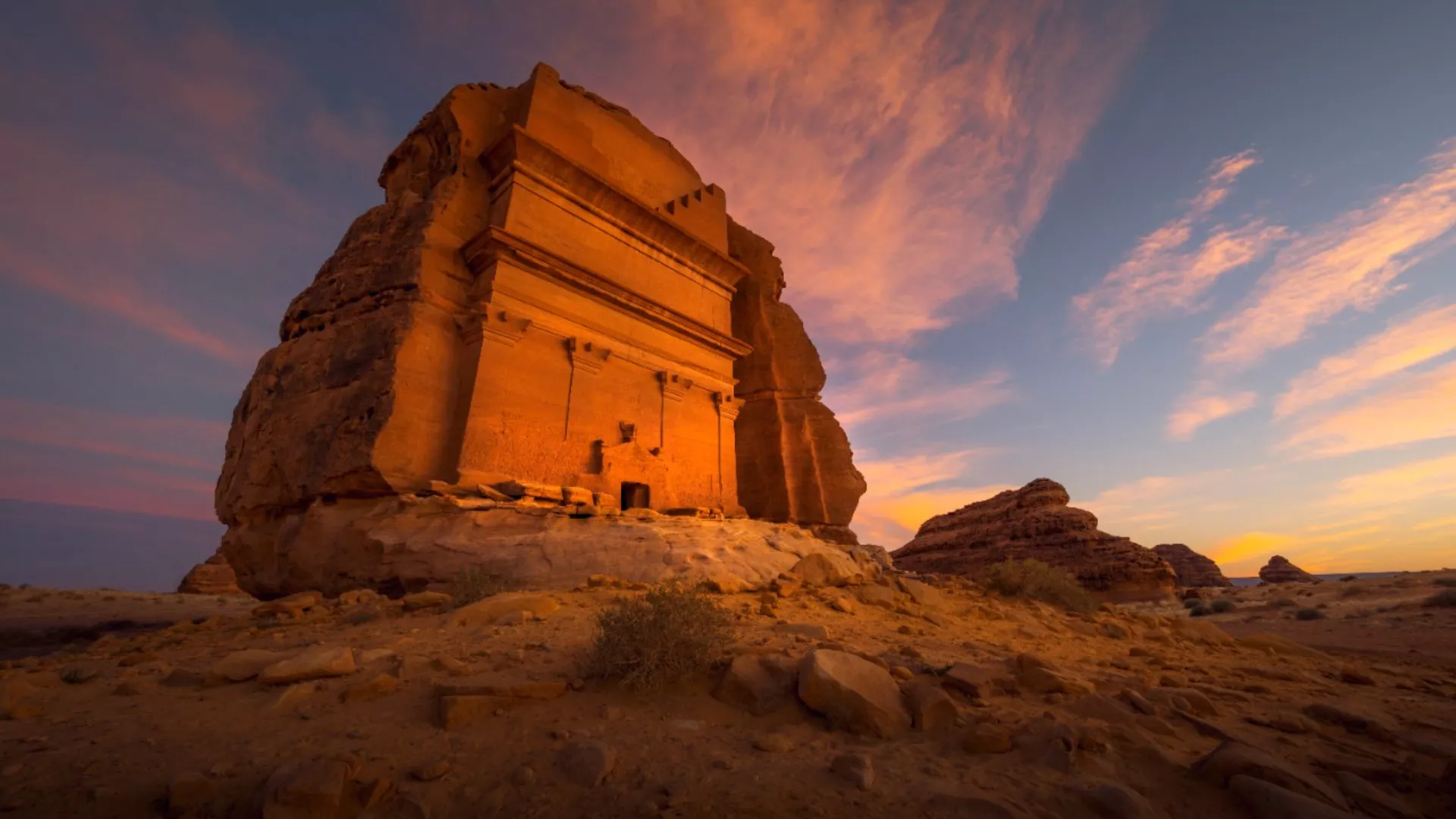
Hegra is Saudi Arabia's first UNESCO World Heritage Site — the largest preserved site of the Nabataean civilisation south of Petra, containing 111 monumental tombs carved into rose-red sandstone cliffs, 94 of them decorated with elaborate facades. It sits in the AlUla valley in the northwest of the Kingdom, approximately 28 kilometres north of AlUla Old Town. It has been open to international visitors only since 2019. In 2024, it received 286,000 visitors. The Royal Commission for AlUla is targeting 380,000 in 2026. The window between these two numbers — between discovery and consolidation — is the right moment to go.
The comparison with Petra is made by almost every serious visitor and is worth taking seriously rather than dismissing as convenient shorthand. Both are Nabataean — built by the same civilisation, in the same architectural register, using the same technique of carving directly into the living sandstone. Both produce the same fundamental encounter: the realisation that people two thousand years ago were doing something with rock that has not been surpassed.
Hegra in Al-Ula is next to Petra of Jordan — an archaeological jewel of the Nabataean civilisation. It is less crowded than Petra, because Saudi Arabia opened its borders to non-Muslim tourism from 2019.
Less crowded than Petra. Open to international visitors for six years. Receiving a third of Petra's annual visitor numbers. These three facts together describe a window that will not remain open indefinitely.
What Hegra Is
The Nabataean civilisation — the merchant culture that controlled the Arabian trade routes from roughly the fourth century BC through the first century AD — built Hegra, known in antiquity as Hegra or Egra, as its second city after Petra. Where Petra was the capital, Hegra was the trading hub through which frankincense, spices, and luxury goods moved from southern Arabia and East Africa toward the Mediterranean.
Hegra holds 111 monumental tombs, 94 of them decorated with elaborate facades, and the surrounding valley stretches across 7,000 years of human history.
The tombs are the primary encounter — cut directly into the vertical faces of free-standing sandstone outcrops that rise from the desert floor. The facades are carved with extraordinary precision: classical pilasters, Nabataean capitals, dedicatory inscriptions naming the tomb's owner and the penalty for misuse, eagles and serpents as protective motifs. The scale is larger than photographs suggest. The precision, given the tools available in the first century AD, produces a specific quality of bewilderment.
Beyond the Nabataean occupation, the valley contains evidence of human presence stretching back 7,000 years — Lihyanite, Dadanite, and earlier cultures whose traces are visible at the adjacent sites of Dadan and Jabal Ikmah, both accessible within the AlUla experience.
The Experience
Access to Hegra is managed through the Experience AlUla booking platform — advance reservation is mandatory and not optional in the way that some heritage sites treat the formality. Tickets sell out during peak months from November to February. Turning up without a booking is not a viable strategy.
The principal tour format is a guided coach experience departing from the Hegra Visitor Centre, approximately two hours in duration, following a circuit of the major tomb clusters with a knowledgeable guide. The visitor centre itself — museum, café, gelato, souvenir shop — is better than expected. Toilets are provided both at the centre and on-site.
The reviews consistently single out the guides as the most important variable in the quality of the experience. A knowledgeable guide who reads the inscriptions, explains the social structure of Nabataean mortuary practice, and connects the individual tombs to the broader trading civilisation transforms the visit from a walk past impressive rockwork into something considerably more resonant.
The alternative tour format — a private Land Rover with a ranger — is consistently described as the stronger option for those who want to control the pace and focus. It allows time at specific tombs rather than the group-managed circuit. Pre-booking through Experience AlUla or a specialist operator is required.
The visit works best in the early morning or late afternoon — the directional light on the sandstone facades at these times produces the colour and shadow contrast that photographs of Hegra consistently show. Midday light flattens the stone. A start time of 6.30am or a late afternoon slot is the booking to aim for.
The Wider AlUla Context
Hegra is the anchor of AlUla — but AlUla is considerably more than Hegra.
AlUla is Saudi Arabia's most extraordinary travel destination — a 22,561-square-kilometre open-air museum where 200,000 years of human history collide with luxury desert camps, Michelin-calibre dining, and landscapes that look borrowed from another planet.
Elephant Rock — a 52-metre natural sandstone formation that requires no archaeological explanation — is twenty minutes from Hegra and produces a different category of visual response. The AlUla Old Town — a layered settlement of mud-brick structures occupied continuously until 1983 — provides the human context that the ancient sites alone cannot. Jabal Ikmah, an open library of pre-Islamic inscriptions carved into canyon walls, is one of the largest collections of ancient writing in the world and receives a fraction of the attention it deserves.
AlUla rewards visitors who mix history with landscape. Layer your itinerary: combine the heritage sites with sensory experiences like stargazing and the Maraya concert hall.
The Maraya concert hall — a mirrored structure that reflects the surrounding desert and has become one of the most photographed buildings in the Middle East — hosts the AlUla Moments programme: an ambitious year-round calendar of music, art, gastronomy, and astronomy events that runs from October through April. The 2025-2026 season, the most ambitious yet, confirms that AlUla's ambition extends well beyond heritage tourism.
AlUla is building towards something much bigger. With airport expansions, new hotels, and rising international awareness, the experience in 2028 will look very different from what's available now. For GCC residents, the proximity is a genuine advantage. A few days, a short flight, and you step into 7,000 years of history before the rest of the world catches up.
The Practical Picture
AlUla is served by Prince Abdul Majeed bin Abdulaziz Airport with direct connections from Riyadh and Jeddah, and seasonal connections from regional hubs. The journey from Riyadh takes approximately two hours by air.
A minimum three-night stay is the consistent recommendation from visitors who have done both shorter and longer trips. The heritage sites alone fill two full days when done properly. The landscape experiences — Elephant Rock, Jabal Ikmah, the desert camps — require additional time.
Book Hegra through the official Experience AlUla platform well in advance. The heritage tours are remarkably affordable — under SAR 200 for the core Hegra experience. The real cost of an AlUla visit is accommodation, which ranges from mid-range options in town to luxury desert camps and the upcoming high-end properties under development.
The best season is October through April — temperatures are manageable and the AlUla Moments programme is active. May through September is hot in a way that limits outdoor activity.
An honest caveat: some visitors report difficulty booking tickets despite advance planning, and customer support for booking queries can be slow to respond. The Experience AlUla platform has improved considerably since 2023 but warrants more lead time than most heritage sites require — six to eight weeks ahead during peak season is not excessive.
Vitae Lifestyle Scorecard
- Archaeological significance9.5 / 10
- Landscape9.5 / 10
- The guide9.0 / 10
- Timing — visit now9.0 / 10
Who it's for
- Anyone who has been to Petra and wondered whether the civilisation that built it left anything else.
- Visitors to Saudi Arabia who want to understand what the country was before what it is becoming.
- Those who prefer to encounter extraordinary places before they become famous rather than after.
Questions
What is Hegra in Saudi Arabia?
Hegra — known in antiquity as Hegra or Egra — is Saudi Arabia's first UNESCO World Heritage Site and the largest preserved site of the Nabataean civilisation south of Petra. It contains 111 monumental tombs carved into rose-red sandstone, 94 with decorated facades, in the AlUla valley in northwestern Saudi Arabia. The site stretches across a valley with 7,000 years of human history. It has been open to international visitors only since 2019.
How does Hegra compare to Petra?
Both are Nabataean — the same civilisation, the same architectural techniques of carving directly into living sandstone, the same dedicatory tomb inscriptions. Petra was the Nabataean capital; Hegra was its second city and southern trading hub. Hegra is less crowded than Petra, open to international visitors for a shorter period, and receives approximately a third of Petra's annual visitors. The facades at Hegra are as impressive as Petra's in scale and precision. The desert landscape setting is different — more open, more austere — and produces a different quality of encounter.
How do you book tickets to Hegra?
Through the official Experience AlUla platform at experiencealula.com — advance booking is mandatory and tickets sell out during peak months from November to February. Six to eight weeks of lead time is recommended during peak season. The principal tour format is a guided coach tour of approximately two hours from the Hegra Visitor Centre. A private Land Rover tour with a ranger is available and consistently described as the stronger option for those who want to control pace and focus.
When is the best time to visit Hegra?
October through April — temperatures are manageable, the directional light on the sandstone facades is at its most dramatic, and the AlUla Moments cultural programme is active. The early morning session at 6.30am or a late afternoon slot produces the best light on the tomb facades. Midday visits flatten the colour of the stone. May through September is very hot and limits outdoor activity.
How long should I spend in AlUla?
A minimum of three nights is the consistent recommendation. The heritage sites — Hegra, Dadan, Jabal Ikmah, AlUla Old Town — fill two full days when done properly. Elephant Rock, the desert landscape experiences, and any AlUla Moments events require additional time. One night or a day trip from elsewhere is insufficient to understand what AlUla is.
Is Saudi Arabia safe to visit?
The FCDO travel advice for AlUla and the northwest of Saudi Arabia recommends normal precautions. Saudi Arabia's e-visa system permits international leisure visitors from the vast majority of countries. AlUla specifically is one of the most developed and visited parts of the country for international tourism and has been welcoming international visitors since 2019 with considerable investment in infrastructure and visitor experience.
This article appears in Edit No. 15 — The Original Middle East


