Birr Castle Demesne: The Estate That Built a Telescope
Experience — Birr Castle Demesne, Co. Offaly
By James B. Stoney, Editor ·
The Parsons family have owned Birr Castle since 1620. In 1845, the 3rd Earl built the largest telescope in the world. It still stands. The box hedges are 12 metres tall. Here's why Birr belongs on any serious Ireland itinerary.
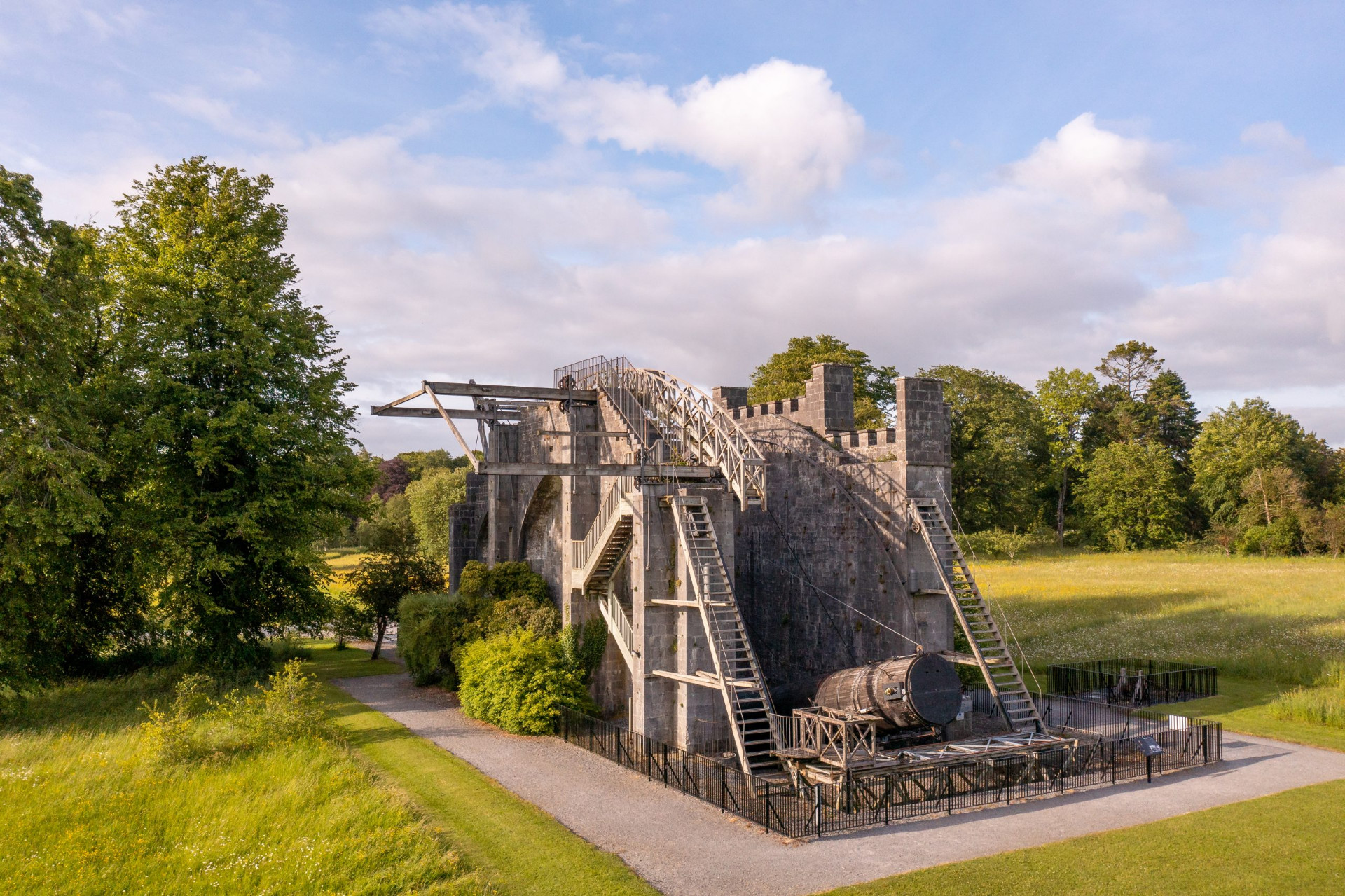
120 acres of gardens and parkland in the Irish Midlands. The tallest box hedges in the world. One of the oldest darkrooms in Europe. And at the far end of the grounds, the restored skeleton of a telescope that was the largest on Earth for 75 years.
Birr Castle Demesne has been home to the Parsons family since 1620 — fourteen generations, the family still living in the castle today. The 120-acre demesne is open to the public. The castle itself is not a heritage site managed by a state body with roped-off rooms and laminated panels. It is a working estate. The difference is immediately apparent on arrival.
Ireland's Midlands are often passed through rather than stopped in.
Birr is worth stopping in.
The Leviathan
In 1845, William Parsons — the 3rd Earl of Rosse — completed construction of a telescope unlike anything that had existed before.
The Leviathan of Parsonstown had a 72-inch speculum metal mirror, ground on site in the grounds of the castle. It required an entirely new construction method — the mirror alone weighed four tonnes, and no existing technique could produce a speculum metal casting of this scale. Parsons designed the casting process himself, built the furnaces in the castle grounds, and oversaw the grinding by hand. The resulting telescope stood between two parallel stone walls, oriented north-south, and moved on a system of chains and counterweights that allowed it to track objects across a narrow strip of sky.
It was the largest telescope in the world and would remain so for 75 years. Scientists and astronomers travelled to County Offaly from across Europe to use it. Through its eyepiece, Parsons became the first person to observe the spiral structure of galaxies — seeing clearly that what had been recorded as fuzzy patches of light in other telescopes were in fact vast rotating systems of stars. It was a discovery of fundamental astronomical significance, made from a field in the Irish Midlands on nights when the Connaught cloud did not intervene.
The original speculum metal was melted down during the First World War. The telescope was reconstructed in the 1990s and stands in the grounds where it was built — enormous, Victorian, and considerably more impressive in person than photographs suggest. The scale of it against the Irish sky is one of those things that requires seeing to register fully.
Adjacent to the telescope, the Science Centre occupies the castle's converted stable buildings. It tells the full Parsons family story — the engineering of the Leviathan, the astronomical discoveries, and the pioneering photography of Mary, Countess of Rosse, whose darkroom in the castle is one of the oldest intact in Europe. She was photographing the moon through the Leviathan in the 1840s. The darkroom survives. The photographs survive. The Parsons family has always had more than one kind of genius.
Castle tours from May to August are guided not by professional guides working from a script but by descendants of the Earl — family members who know the portraits in the Victorian dining room personally. This distinction produces a very different kind of visit from the standard heritage site experience.
The Gardens
The 120 acres contain over 5,000 plant species — specimens collected by successive generations of the Parsons family from across the world, planted over two centuries and now reaching the maturity that makes them extraordinary.
The box hedges are the feature most visitors do not expect. They line one of the formal garden paths at approximately 12 metres — officially the tallest in the world — and walking between them produces a specific spatial experience that no amount of description prepares you for. The enclosure is complete. The sound of the estate disappears. The light changes. It is a garden feature that functions almost architecturally, and the experience of moving through it sits somewhere between walking through a cathedral and walking into another century.
Elsewhere in the grounds: a lake surrounded by specimen trees that have been growing for a hundred and fifty years, river walks along the Camcor, a cascade, a suspension bridge. The gardens were among the first in Ireland to receive specimens of Dawn Redwood after its discovery in China in 1945 — a detail that illustrates both the family's botanical ambitions and their connections across the scientific world. The tree now stands at considerable height. The family planted it knowing they would not see it mature. Several generations of the Parsons family have operated on this timescale.
A LOFAR radio-astronomy station — part of the International LOFAR Telescope network — sits within the grounds, linking Birr's 19th-century astronomical heritage directly to 21st-century radio science. The station detects signals from objects billions of light years away. The Leviathan stands a few hundred metres across the grass. The distance between 1845 and now collapses in a way that most heritage sites cannot produce.
The Connections
The Parsons estate in the 19th century was not simply a private home. It was a centre of serious scientific inquiry that attracted and shaped some of the most important engineering and scientific figures of the Victorian period.
Bindon Blood Stoney studied at Birr for a time. The scientific environment of the estate and the influence of the 3rd Earl's methods — the casting, the grinding, the large-scale precision engineering — were formative for the engineers and scientists who passed through. Stoney went on to become Dublin Port's chief engineer, designing the diving bell that built the city's deep-water quay walls and now stands as a restored exhibit on Sir John Rogerson's Quay in the Docklands. His brother, George Johnstone Stoney, coined the term "electron."
The Parsons family itself continued to produce extraordinary figures. Charles Parsons — son of the 3rd Earl — invented the steam turbine in 1884, an achievement that transformed naval propulsion and power generation globally and is still in use in a direct line of descent from that original design. The tendency of this particular family to change how the world works is not coincidental. It is what happens when serious resources are applied to serious curiosity across multiple generations.
The Town
Birr is a Georgian market town and considerably more interesting than its position in the Irish Midlands would suggest.
The architecture is intact in a way that towns closer to Dublin are not — the streets around the castle lined with buildings that have not been substantially altered since they were constructed, their proportions undisturbed by the retail signage and modern interventions that have changed the character of so many Irish market towns. The effect is of a town that time has treated kindly, which is partly luck and partly the influence of an estate that took the quality of its surroundings seriously.
The pubs have live music. The food scene — for a midlands town — punches well above its weight. There is a Saturday market. There is a distillery. The combination of the demesne and the town makes a full day of it with ease — the castle and grounds taking a serious morning or afternoon, the town taking the rest.
Visitors who plan a single day and find it insufficient are not making an error. They are making the correct response to Birr.
Related reading: Dublin's Diving Bell: The Engineering That Built a City · Hegra, AlUla: Saudi Arabia's Answer to Petra — and Why to Go Now · Ballynahinch Castle, Connemara: The Hotel the Landscape Deserves
Vitae Lifestyle Scorecard
- The telescope9.6 / 10
- The gardens9.6 / 10
- The science9.0 / 10
- The town9.0 / 10
Who it's for
- Those who find that the places they remember longest are the ones they did not expect to find.
- Anyone with an interest in Victorian science, engineering, or photography who has not yet been to Birr.
- Visitors to Ireland who have done the obvious things and are ready for something that requires a little more intent to reach.
Questions
What is Birr Castle Demesne?
A 120-acre estate and historic science centre in the heritage town of Birr, County Offaly — home to the Parsons family since 1620. The demesne includes the restored Leviathan telescope, award-winning gardens with over 5,000 plant species, Ireland's Historic Science Centre, one of the oldest intact darkrooms in Europe, and the world's tallest box hedges. The castle itself remains a private family home. Guided castle tours run from May to August led by family descendants.
What is the Leviathan telescope at Birr Castle?
The Leviathan of Parsonstown was built in 1845 by the 3rd Earl of Rosse — William Parsons — with a 72-inch speculum metal mirror ground on site in the castle grounds. For 75 years it was the largest telescope in the world. Through it, Parsons made the first observation of the spiral structure of galaxies. The original speculum metal was melted during the First World War. The telescope was reconstructed in the 1990s and stands in the grounds where it was built.
What is the connection between Birr Castle and Bindon Blood Stoney?
Bindon Blood Stoney — the Victorian engineer who designed Dublin's diving bell, now a restored exhibit on Sir John Rogerson's Quay in the Docklands — studied at Birr for a time. The scientific environment of the Parsons estate and the influence of the 3rd Earl's large-scale precision engineering were formative for several engineers and scientists who passed through during the 19th century. Stoney went on to become Dublin Port's chief engineer and one of the most significant infrastructure figures in Victorian Ireland. His brother George Johnstone Stoney coined the term "electron."
What are the gardens like at Birr Castle?
120 acres containing over 5,000 plant species, specimen trees planted over two centuries, a lake, river walks along the Camcor, and the world's tallest box hedges at approximately 12 metres. The gardens were among the first in Ireland to receive Dawn Redwood specimens after their discovery in China in 1945. A LOFAR radio-astronomy station within the grounds connects Birr's 19th-century astronomical heritage to 21st-century radio science.
Is Birr Castle still privately owned?
Yes — the Parsons family have owned the estate since 1620 and continue to live in the castle today across 14 generations. The 120-acre demesne is open to the public. Castle tours from May to August are guided by family descendants.
How long does a visit to Birr Castle take?
The demesne and science centre merit a full morning or afternoon. Combined with the town of Birr — Georgian architecture, Saturday market, distillery, pubs and a food scene that exceeds expectations — a full day is well spent. Visitors who allow less time consistently wish they had allowed more.
How do you get to Birr Castle from Dublin?
Approximately 130 kilometres from Dublin — around 90 minutes by car via the M6 or N62. Birr is in County Offaly in the Irish Midlands. The drive through the Irish countryside is unremarkable until it is not.
This article appears in Edit No. 16 — Ireland


