Information, Without Control: Nexus by Yuval Noah Harari — Review
Reading — Nexus
By James B. Stoney, Editor ·
Nexus reframes information not as something neutral, but as the structure that shapes how people act — and what changes when machines begin shaping it too.
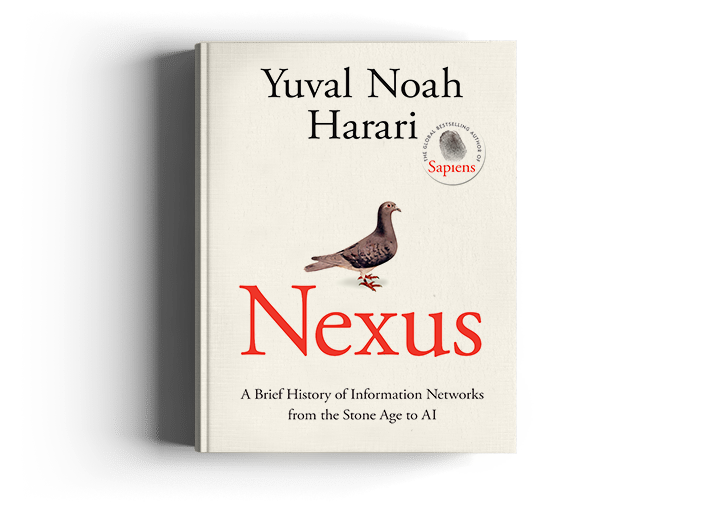
We tend to assume that more information leads to better decisions.
Nexus challenges that directly.
Rather than treating information as something neutral, the book argues that it is the structure around information — how it is shared, repeated and believed — that shapes behaviour. That has been true from early human societies through to the present.
What has changed is the scale.
Information as Structure
The central idea is simple.
Human systems are built on shared narratives — not necessarily truth, but agreement. Religion, money, politics and institutions all depend on this.
Information, in that sense, is not just descriptive.
It is organisational.
The networks that carry it determine how people act.
Scale and Acceleration
What feels different now is speed.
Digital systems distribute information instantly, repeatedly and at scale. The volume increases, but clarity does not. Signals and noise begin to merge.
The result is not better understanding.
It is compression.
Decisions are made faster, often with less context.
The Role of AI
The book's more recent focus is on artificial intelligence.
For the first time, information systems are no longer entirely human-led. Machines are generating, shaping and distributing content within those same networks.
That shift is not framed as a technical change.
It is structural.
If information shapes behaviour, and machines shape information, then the influence moves beyond human control.
Where It Lands
Nexus is not always precise.
At times, it moves broadly across history, connecting ideas that do not always hold at a detailed level. But that is not its strength.
What it does well is frame the present moment.
It puts language around something familiar: the sense that more information has not made things clearer, only more continuous.
Who Nexus is for
Nexus is not a technical book. It does not require familiarity with AI, computer science, or economics to follow. Harari writes for a general audience and the argument is built from historical observation rather than specialist knowledge.
It suits those who want a framework for thinking about the present moment — why attention feels fragmented, why information volume has not produced clarity, and why the arrival of AI feels structurally different from previous technological shifts. It is less useful as a practical guide and more valuable as a lens.
Those who found Sapiens or Homo Deus useful will find Nexus a natural continuation. Those coming to Harari for the first time will find it accessible, if occasionally broad in its historical sweeps.
Why It Earns Its Place
There are many books about technology.
Fewer focus on how information itself behaves.
Nexus is most useful not as a guide, but as a lens — something that helps explain why attention feels fragmented, why decisions feel compressed, and why clarity is harder to maintain.
It pairs naturally with the slower, foundational thinking that the Reset Companion is built around — a quiet counterweight to the continuous information environment the book describes.
Vitae Lifestyle Scorecard
- Relevance9.3 / 10
- Clarity of ideas8.9 / 10
- Depth8.7 / 10
- Overall impact9.1 / 10
Who it's for
- Those interested in how information shapes behaviour.
- People thinking about attention, decision-making and modern life.
- Anyone looking for a broader framework rather than practical instruction.
Questions
What is Nexus by Yuval Noah Harari about?
Nexus is a book examining the history and nature of information networks — from early human societies and religious institutions through to digital platforms and artificial intelligence. Its central argument is that information is structural rather than neutral: the networks that distribute it shape behaviour, belief, and social organisation. The book's second half focuses on AI as the first information system that is not entirely human-led.
How does Nexus compare to Sapiens and Homo Deus?
Nexus shares Harari's broad historical approach but has a tighter focus than either Sapiens or Homo Deus. Where Sapiens covered the full arc of human history and Homo Deus speculated about the future, Nexus concentrates on information specifically — tracing how networks of shared narrative have always shaped human systems, and what changes when AI enters those networks. It is more focused and arguably more urgent in its argument than the earlier books.
Is Nexus worth reading?
Nexus is most valuable as a framework for understanding the present moment rather than as a source of specific predictions or recommendations. It puts language around something familiar — the sense that more information has not produced more clarity — and places that feeling in a longer historical context. At times it moves broadly across history, but its core argument is clear and the framing of AI as a structural shift rather than a technical one is genuinely useful.
Where can you buy Nexus by Yuval Noah Harari?
Nexus is available through major UK booksellers including Waterstones, Amazon, and independent bookshops. It is published by Jonathan Cape and available in hardback, paperback, and ebook formats.
This article appears in Edit No. 10 — On Information and Attention


