Ape Nutrition Beef Protein: Five Ingredients, One Big Claim

Product — Ape Nutrition

By James B. Stoney, Editor ·

A grass-fed beef protein with five real ingredients and no sweeteners — and a positioning claim that does not quite hold.
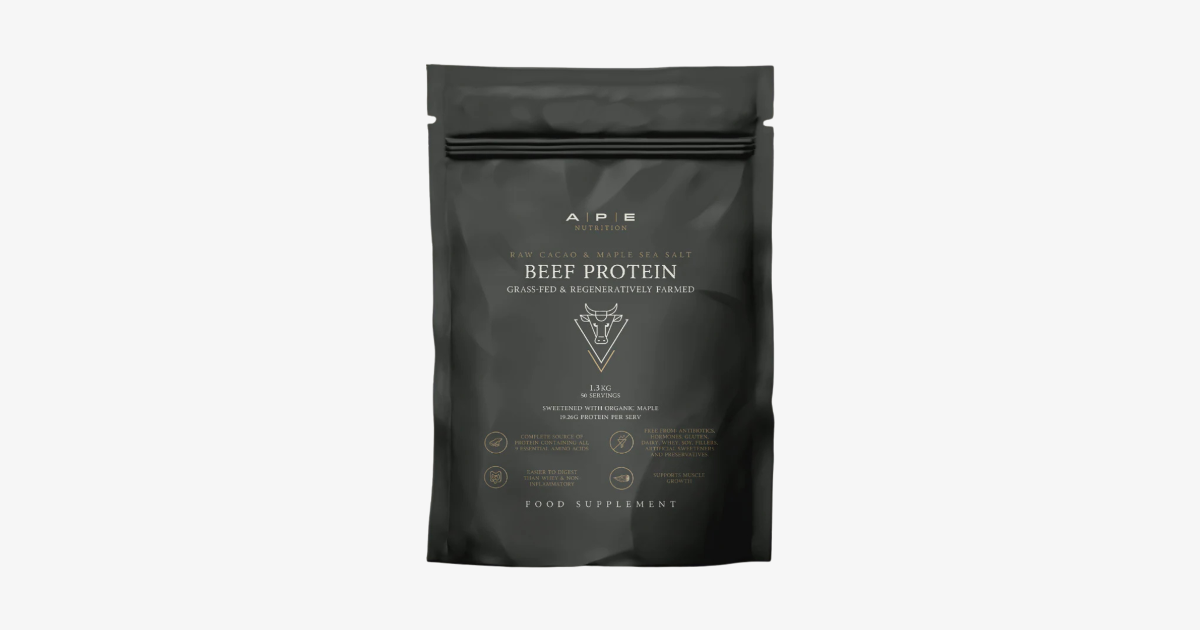
Ape Nutrition beef protein raw cacao and maple sea salt — grass-fed regeneratively farmed pack
Image: Ape Nutrition

Read the ingredients on most chocolate protein powders and the list runs long.

Whey concentrate, cocoa, sucralose, acesulfame K, xanthan gum, natural and artificial flavourings, emulsifiers, anti-caking agent.

Ape's raw cacao contains five things: grass-fed beef protein, organic maple sugar, raw cacao powder, Madagascan vanilla, sea salt.

That is the whole product.

A Different Premise

The protein category has spent two decades optimising for two variables — grams per scoop and cost per kilo — and treating everything else as overhead.

Ape works from the opposite direction. The formulation starts with what should be in it rather than what can be stripped out of the price.

The cattle are grass-fed and regeneratively raised on KRAV-approved Swedish farms, free from antibiotics and hormones, with standards covering biodiversity, climate impact and animal welfare. The vanilla is actual Madagascan vanilla rather than a synthetic analogue. The sweetness comes from a small amount of maple sugar rather than sucralose.

None of that is standard. Most of it is expensive.

How It Tastes

It tastes like dark chocolate, in the 70 to 85 per cent range.

Which is to say it is not very sweet, and if your reference point is a conventional chocolate whey it will read as under-flavoured. Ape's own response to a customer complaint on this point is unusually direct: the flavour profile is different because they use real ingredients and no artificial sweeteners, and that takes adjustment.

That is honest, and it is also the trade. A powder without sucralose tastes like a powder without sucralose. Some people will find it a relief. Others will add honey or fruit, which the brand openly suggests.

Being beef-derived, there is a faint savoury note underneath. It disappears in a shake with anything else in it. Taken with water alone, it does not.

Ape Nutrition Foundation Bundle — beef protein, collagen powder and beef organs capsules in a sunlit Swedish pasture with grass-fed cattle
Image: Ape Nutrition

The Claim That Doesn't Hold

Ape positions beef protein as non-inflammatory and easier to digest than whey, soy or plant proteins — the implication being that it is the better choice generally.

That is where the piece has to be careful.

For building muscle specifically, whey remains the better-evidenced option. It is higher in leucine, the amino acid that most directly triggers muscle protein synthesis, and has a more favourable amino acid profile for that purpose. Beef protein powders are typically derived in part from collagen, which is not a complete protein and is notably low in the aminos that matter most for muscle.

There is also a small internal tension in the marketing. The product is described as rich in collagen and as a complete protein containing all nine essential amino acids. Both can be technically true of a blend, but they pull in different directions, and the collagen content is the reason the leucine figure will not match whey.

None of this makes it a bad protein. It makes it a different one.

Wider Context

Where the product genuinely earns its position is the group whey does not serve.

Anyone who bloats on whey, avoids dairy, reacts to soy, or dislikes the texture of pea and rice blends has a limited set of options — and most of what remains is heavily sweetened and thinly sourced. A clean, dairy-free, soy-free protein with five recognisable ingredients is a real answer to a real problem.

The collagen content, framed correctly, is a genuine secondary benefit rather than a muscle-building one: collagen peptides have reasonable evidence for connective tissue, tendon and skin, which whey does not provide.

The cost is the other consideration. At £59.99 for 1.27kg — roughly fifty servings at around 20g of protein each — this is comfortably above what a whey concentrate costs per gram. You are paying for sourcing, ingredient quality and the absence of things, not for protein density.

Why It Earns Its Place

Because the execution is excellent even where the positioning overreaches.

Five ingredients, all identifiable. Sourcing that is specific rather than vague. No sweeteners, no fillers, no flavour system. A brand that answers a taste complaint by explaining the formulation rather than reformulating toward sucralose.

If you want the most efficient gram of muscle-building protein for the money, this is not it, and the marketing should not persuade you otherwise.

If you want protein made from actual food, tolerate it better than whey, and value what is absent as much as what is present, it is one of the more honestly built products in a category not known for it.

Vitae Lifestyle Scorecard

  • Ingredient quality9.6 / 10
  • Sourcing9.5 / 10
  • Taste8.7 / 10
  • Value8.2 / 10
Overall9.0 / 10

Who it's for

  • Those who react badly to whey or dairy and want a clean alternative without artificial sweeteners.
  • People who prioritise sourcing and ingredient transparency over cost per gram.
  • Not the best option for maximising muscle protein synthesis, where whey remains better evidenced.

Questions

What is Ape Nutrition beef protein?

A grass-fed beef protein powder made with five ingredients — beef protein, organic maple sugar, raw cacao powder, Madagascan vanilla and sea salt. It contains around 19.9g of protein per 25g serving, is free from dairy, whey, soy, fillers, artificial sweeteners and preservatives, and is sourced from KRAV-approved regenerative Swedish farms.

Is beef protein better than whey?

Not for muscle building. Whey is higher in leucine, the amino acid that most directly stimulates muscle protein synthesis, and has a more favourable profile for that purpose. Beef protein powders typically include collagen-derived material, which is not a complete protein. Beef protein's genuine advantage is for those who don't tolerate whey or dairy.

What does it taste like?

Like dark chocolate in the 70–85% range — noticeably less sweet than conventional chocolate whey, because there are no artificial sweeteners. There is a faint savoury note from the beef base, which disappears when blended with other ingredients but is detectable with water alone. The brand suggests adding honey or fruit for more sweetness.

Is the collagen content a benefit?

Yes, but not for muscle. Collagen peptides have reasonable evidence supporting connective tissue, tendon and skin, which whey does not offer. The confusion arises when collagen content is presented alongside claims about complete protein and muscle growth, since collagen is low in the amino acids that matter most for that.

What does it cost?

Around £59.99 for 1.27kg, which works out at roughly fifty servings. That is meaningfully more per gram of protein than a standard whey concentrate. The premium reflects sourcing, ingredient quality and the absence of fillers and sweeteners rather than protein density.