Neko Health: What a £299 Full Body Scan Actually Buys
Product — Neko Health
By James B. Stoney, Editor ·
A sixty-minute preventative scan producing millions of data points, read back by a doctor before you leave.
Most health data arrives too late.
You feel something, you wait for an appointment, you are tested for the thing you already suspect. The system is built to respond rather than to observe.
Neko proposes the opposite order.
A Different Premise
Founded by Daniel Ek and Hjalmar Nilsonne, the ambition is closer to infrastructure than clinic. The scan is designed to be repeated annually, each visit compared against the last.
That is the actual product. Not the scan — the series.
A single reading tells you little. A reading measured against your own from a year ago tells you the direction of travel, which is the thing that matters and the thing almost nobody has.
What Happens
The clinic on St Vincent Street does not look like a clinic. It looks like a well-funded idea about what a clinic could be — pale, minimal, quiet.
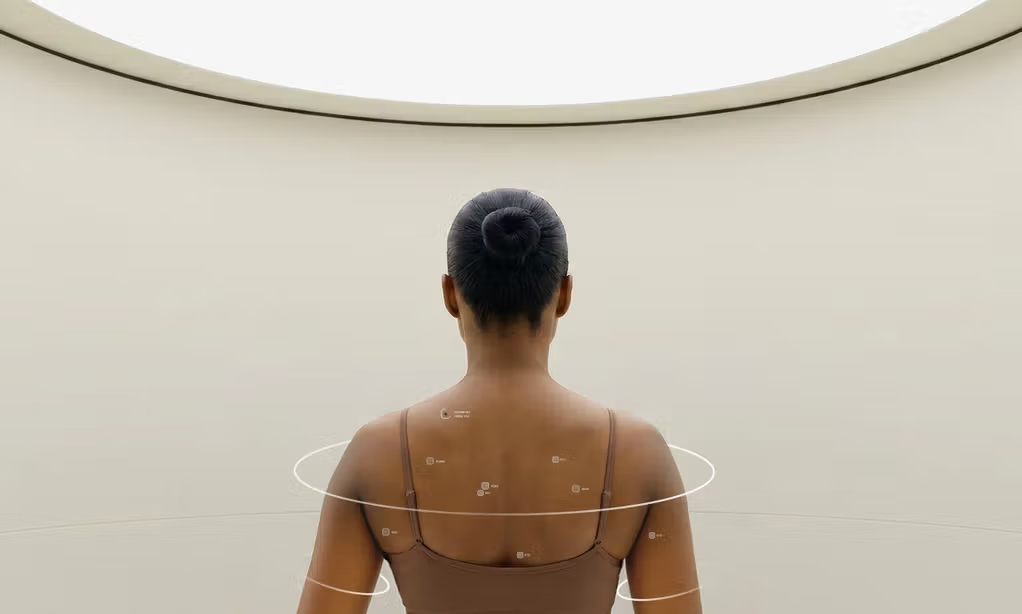
The scan takes minutes. A pod captures thousands of high-resolution images to build a three-dimensional map of the body and photograph every mole. Laser thermal imaging follows, reading cardiovascular markers. A nurse adds grip strength, blood pressure, eye pressure and an ECG. A blood sample goes upstairs to the on-site laboratory by vacuum tube — theatrical, and also fast enough that results return within the same appointment.
Then the part that distinguishes it: you sit with a doctor, who reads the whole thing back to you.
Not an app. Not a PDF. A person, in a room, for twenty minutes.
What It's Actually For
Neko is not diagnosing symptoms. It is establishing a baseline.
Skin is mapped so a mole can be compared against its own photograph next year. Cardiovascular and metabolic markers are recorded so a drift becomes visible while it is still a drift. Mole images are reviewed by a dermatologist within the fee.
The company's first-year figures from Stockholm state the intent clearly: of 2,707 people scanned, 78.5% had no issues identified, 14.1% had findings requiring further medical attention, and 1% had serious cardiovascular, metabolic or cancerous conditions — none of whom knew beforehand.
That 1% is the argument for the enterprise. It is also the number requiring the most careful reading.
Wider Context
Whole-body screening of people without symptoms is genuinely contested in medicine.
The objection is not that the tests are bad. It is that screening healthy populations reliably produces findings that would never have caused harm — but which, once seen, must be investigated. Follow-up appointments, further imaging, occasionally biopsies, and a period of anxiety, all arising from something that was never going to matter. The term is overdiagnosis, and the cost is borne by a much larger group than the group that benefits.
Neko sits more defensibly within this debate than most. Its components are established clinical tests rather than speculative ones. Findings are read by a doctor who can contextualise them rather than delivered raw. The pricing is a fraction of the MRI-based competitors. Mole mapping in particular has a reasonable case, since serial photography genuinely is how change is detected.
But the tension does not disappear. Some proportion of that 14.1% leads somewhere useful, and some is noise that generates worry and appointments. The company reports the first number. Nobody reports the second.
Why It Earns Its Place
Because it is honest about what it is.
Neko does not claim to replace medical care, diagnose disease, or substitute for a GP. It offers a structured, repeatable, comparatively affordable baseline, explained by a doctor, in an hour.
For someone with no symptoms, no family history and no particular concern, that may be £299 spent on reassurance — a legitimate thing to buy, provided it is understood as such.
For someone who has never had cardiovascular markers measured, whose moles have never been photographed, or who has quietly avoided finding out, it is more useful than that.
The value is not in the first scan. It is in the second.
Vitae Lifestyle Scorecard
- Experience9.5 / 10
- Clarity of results9.4 / 10
- Clinical value8.6 / 10
- Overall experience9.1 / 10
Who it's for
- Those who want a structured annual baseline and will return to make the comparison meaningful.
- People who have never had cardiovascular or metabolic markers measured, or moles professionally mapped.
- Less suited to those prone to health anxiety, for whom incidental findings may cost more than the reassurance is worth.
Questions
What is Neko Health?
A preventative health company founded by Daniel Ek and Hjalmar Nilsonne, offering a full-body scan designed to be repeated annually. An appointment lasts around an hour and includes body and mole scanning, laser thermal imaging, blood tests processed on site, functional measures such as grip strength and eye pressure, an ECG, and a doctor consultation.
What does it cost and where are the clinics?
£299 per scan, with subsequent scans at reduced cost. UK clinics are in London — Marylebone and Spitalfields — and Manchester, alongside the original Stockholm sites. Demand has generated a substantial waiting list.
What does the scan detect?
It targets early detection of cardiovascular disease, metabolic conditions including type 2 diabetes, and skin cancer. Mole images are reviewed by a dermatologist within the fee. In Neko's first Stockholm year, 78.5% had no issues identified, 14.1% required further medical attention, and 1% had serious conditions they were unaware of.
Is whole-body screening actually a good idea?
It is debated. Screening people without symptoms reliably produces findings that would never have caused harm but must still be investigated — overdiagnosis, which carries costs in anxiety, appointments and further testing. Neko's position is stronger than much of the field, but the tension is real and worth understanding before booking.
Does it replace seeing a GP?
No, and Neko does not claim it does. It is a baseline and monitoring tool, not a diagnostic service. Anyone with symptoms should see a doctor rather than book a scan, and findings are referred onward for medical follow-up.
This article appears in Edit No. 23 — Six Products, Measured Against Their Own Claims


