Dublin's Diving Bell: The Engineering That Built a City

Experience — The Diving Bell, Dublin Docklands

By James B. Stoney, Editor ·

A 90-tonne Victorian diving bell on Sir John Rogerson's Quay. Designed by Bindon Blood Stoney, born in County Offaly. Used to build Dublin's deepwater quays for 87 years. Free to visit. Almost nobody stops.
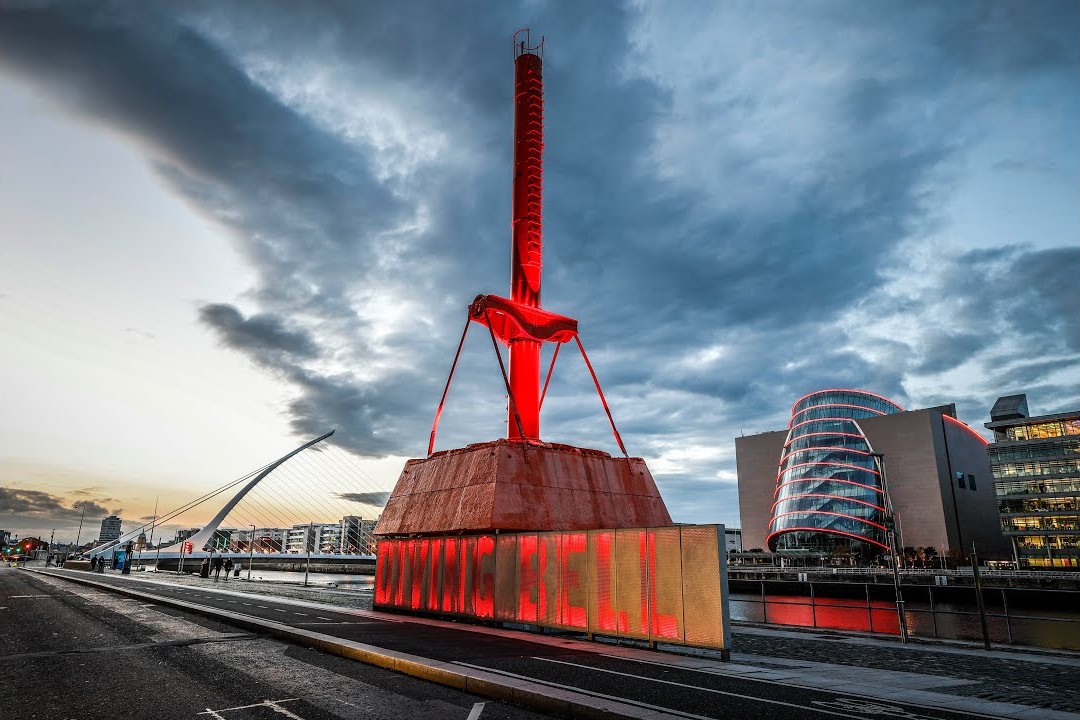
The restored Diving Bell on Sir John Rogerson's Quay in the Dublin Docklands, lit red at dusk with the Samuel Beckett Bridge and the Convention Centre Dublin behind
Image: Dublin Port — the Diving Bell on Sir John Rogerson's Quay

A 90-tonne cast-iron diving bell on Sir John Rogerson's Quay in the Dublin Docklands. Designed in 1860. Built in Drogheda in 1866. In service from 1871 until 1958. Free to visit. Almost nobody stops.

The Diving Bell is a free interpretive exhibition on Sir John Rogerson's Quay in Dublin's Docklands — a 90-tonne Victorian cast-iron structure designed by port engineer Bindon Blood Stoney and used to build Dublin's deepwater quay walls for 87 years. It was restored by Dublin Port Company in 2015 and raised onto a display structure with a small museum beneath it.

Most people walk past it.

Most people are missing something.

The Bell

A black-and-white photograph from the 1940s showing the original Bindon Blood Stoney diving bell in operation in Dublin Port, a workman standing on a precast concrete block beside the bell in the River Liffey
Image: History Ireland — the diving bell in operation in Dublin Port, 1940s

Dubliners have been walking past the Diving Bell for generations — past the odd-looking, bell-shaped, orange-red metal structure standing on the south docks quay — and assuming it is modern public art, or misplaced industrial equipment, or simply something that belongs to someone else's itinerary.

It is in fact one of the most significant pieces of Victorian engineering in Ireland.

The bell is hollow and open at the bottom. In operation, it was lowered from a floating barge into the bed of the River Liffey. A crew of six workmen entered through an airlock shaft that projected above the water surface. Compressed air was pumped in, keeping the water out. The men worked in the pressurised chamber below — levelling the riverbed and laying the gravel foundations onto which Stoney's massive precast concrete blocks, each weighing up to 350 tonnes, were then lowered to form the quay walls.

The chamber was twenty feet square and six and a half feet high. The temperature inside quickly became unbearably hot. Shifts were short. The work produced the quays that Dublin still uses.

It entered service in 1871. It was in continuous use until 1958. The North Wall extension, Alexandra Basin, Sir John Rogerson's Quay itself — all of it built using the bell.

The Engineer

Bindon Blood Stoney was born in 1828 at Clareen in County Offaly — the same county as Birr Castle, where he studied for a time under the influence of the 3rd Earl of Rosse and the scientific environment of the Parsons estate.

He became Chief Engineer to the Dublin Ballast Board — later Dublin Port and Docks Board — and held the role from 1856 to 1898. The diving bell was his most significant innovation: a new method of building dock walls using prefabricated precast concrete rather than hand-laid stone, with the bell providing the pressurised working environment that made precision underwater construction possible. The approach attracted considerable international attention and was studied by engineers from across the world.

Among his other achievements: O'Connell Bridge, the Boyne Viaduct in Drogheda, and much of Dublin's surviving Victorian port infrastructure. His brother, George Johnstone Stoney, coined the term "electron." The family produced, from a small county in the Irish Midlands, two men who between them changed how cities are built and how physics is discussed.

The diving bell Stoney designed remained in use for 87 years — a measure of how well he understood what he was building and what it needed to do.

The Exhibition

Inside the restored Diving Bell exhibition beneath the raised bell on Sir John Rogerson's Quay — blue-lit display panels and an interpretive walkway showing the original interior of the working chamber
Image: Dublin Port — the interpretive exhibition beneath the bell

The small museum beneath the raised bell tells the full story — Stoney's engineering method, the working conditions inside the bell, the expansion of Dublin Port across the Victorian era, and the bell's near-disappearance. It was saved from scrapping by port staff and placed on display in 2000 before Dublin Port Company undertook the formal restoration project that produced the current interpretive exhibition in 2015.

A hole cut in the side of the bell allows visitors to look into the hollow, open-ended interior — to understand the scale of the working chamber and the conditions in which six men levelled the bed of the Liffey in the 1870s and 1880s. The vertical access shaft visible above is a replica. Everything else is original.

The exhibition is free. It takes around twenty minutes. It is the most concentrated piece of Dublin industrial heritage available to anyone on a walk along the south quays.

The Docklands Context

The Diving Bell standing on Sir John Rogerson's Quay in daylight, the Samuel Beckett Bridge spanning the Liffey behind it, modern Docklands office buildings on either side
Image: Dublin Port — the Diving Bell at the western end of Sir John Rogerson's Quay

The Diving Bell sits at the western end of Sir John Rogerson's Quay — the stretch of south docks quay that runs east from the Samuel Beckett Bridge toward Grand Canal Dock. The area has been the most dramatically transformed part of Dublin over the past three decades: the tech campuses, the hotels, the Grand Canal Theatre, the new residential developments along the waterfront.

The Diving Bell is the object that makes visible what was here before all of this. The quay it sits on was built using the bell. The docks it served made Dublin a functioning port city. The transformation that produced the Docklands as it exists today was only possible because Victorian engineers built the infrastructure that allowed the city to expand.

The bell does not require context to be interesting. But the context makes it more so.

Related reading: Birr Castle Demesne: The Estate That Built a Telescope · Hegra, AlUla: Saudi Arabia's Answer to Petra — and Why to Go Now · The Best Independent Bookshops in London Right Now

Vitae Lifestyle Scorecard

  • The engineering9.8 / 10
  • The story9.8 / 10
  • The exhibition9.0 / 10
  • The location9.8 / 10
Overall9.6 / 10

Who it's for

  • Those who find that the most interesting things in a city are rarely the most visited.
  • Anyone with an interest in Victorian engineering, Dublin history, or the specific pleasure of understanding how a place was made.
  • Visitors to Dublin who have done the Book of Kells and want something that requires a little more intent to find.

Questions

What is the Diving Bell in Dublin?

A 90-tonne Victorian cast-iron diving bell on Sir John Rogerson's Quay in the Dublin Docklands — designed by port engineer Bindon Blood Stoney, built in Drogheda in 1866, and used to build Dublin's deepwater quay walls from 1871 until 1958. It was restored by Dublin Port Company and opened as a free interpretive exhibition in 2015, raised onto a display structure with a small museum beneath it.

Who was Bindon Blood Stoney?

Bindon Blood Stoney was born in 1828 at Clareen in County Offaly and became Chief Engineer to the Dublin Ballast Board from 1856 to 1898. He designed the diving bell as part of a new method of quay wall construction using precast concrete blocks — an approach that attracted international attention. He also built O'Connell Bridge and the Boyne Viaduct. His brother George Johnstone Stoney coined the term "electron." Stoney studied for a time at Birr Castle under the influence of the 3rd Earl of Rosse, whose scientific environment shaped several of the great Victorian engineers who passed through County Offaly.

How did the Diving Bell work?

The bell was lowered from a floating barge into the bed of the River Liffey. A crew of six workmen entered through an airlock shaft projecting above the water. Compressed air pumped into the chamber kept the water out. The men worked in the pressurised interior, levelling the riverbed to receive Stoney's massive precast concrete blocks — each weighing up to 350 tonnes — which were then lowered to form the quay walls. The chamber was twenty feet square and six and a half feet high. Shifts were short due to the heat.

Is the Diving Bell free to visit?

Yes — the interpretive exhibition beneath the raised bell is free to visit. It takes around twenty minutes and tells the full story of Stoney's engineering method, the bell's 87 years of continuous use, and its near-disappearance before being saved by port staff.

Where exactly is the Diving Bell in Dublin?

On Sir John Rogerson's Quay on the south bank of the Liffey in the Dublin Docklands — at the western end of the quay, near the Samuel Beckett Bridge. It is a ten-minute walk from Trinity College and easily combined with a walk along the south docks toward Grand Canal Dock.

Why does the Diving Bell matter?

It built the quays that Dublin still uses. The North Wall extension, Alexandra Basin, Sir John Rogerson's Quay itself — all constructed using the bell between the 1870s and 1950s. It is the object that makes visible the Victorian infrastructure on which the modern city was built, sitting in plain sight on the south docks quay that it helped to construct.

This article appears in Edit No. 16 — Ireland