Supply Life Intolerance Test: What It Can Actually Tell You

Product — Supply Life

By James B. Stoney, Editor ·

A well-run at-home intolerance test built on a method the major allergy bodies do not endorse. What arrived, what it said, and what to make of it.
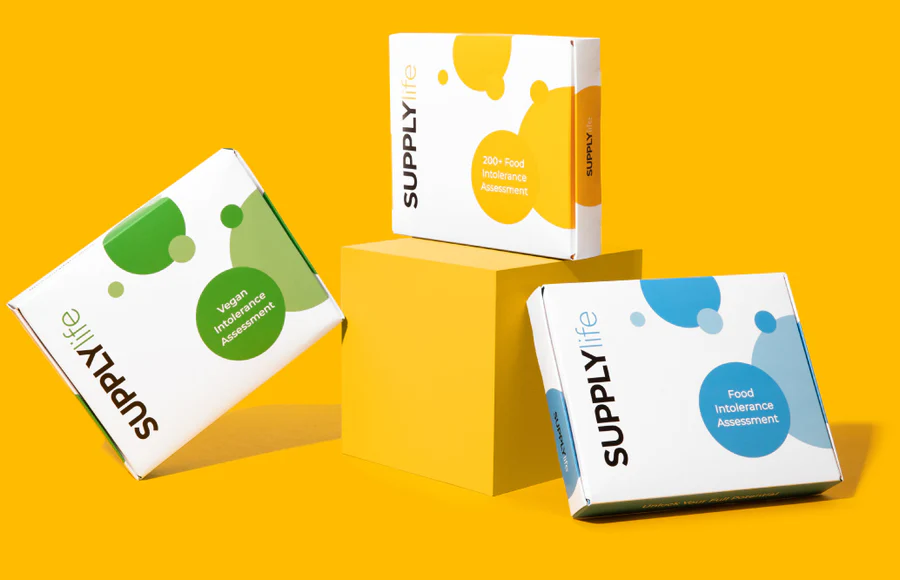
Supply Life food intolerance test kits — three product boxes on a yellow background
Image: Supply Life

My results came back red for dairy, eggs and soy.

Three foods I eat most weeks. The report was clear, well presented, and arrived within a week.

The question is what it actually means.

A Different Premise

Most people who take an intolerance test are not looking for data.

They are looking for an explanation — for the bloating, the afternoon collapse, the sense that something in the diet is not working. The NHS route to that answer is slow and, short of coeliac disease or true allergy, often inconclusive.

Supply Life sells the shortcut. A finger-prick sample at home, a prepaid envelope, an accredited UK lab, a colour-coded report against 200-plus foods inside seven days.

As a service, it is well built.

The Process

The kit is straightforward. Four or five drops of blood, a lancet, a return envelope.

Samples are processed by microarray in an ISO-accredited UK laboratory, and each is run twice. The doubling addresses reproducibility, which is a genuine weakness in cheaper kits using hair analysis or bioresonance.

Results arrive graded. Green, amber, red.

What follows is better than most: a call with a nutritionist, a tailored meal plan, thirty days of support. That aftercare does the most work, and it is what competitors most often charge extra for or omit.

Supply Life food intolerance test kit contents — box, sample collection pack, lancets, alcohol wipes and biological substance envelope, flat-lay on yellow
Image: Supply Life

What the Test Measures

Here the piece has to slow down.

Supply Life measures IgG antibodies — subclasses 1 through 4 — against each food. A high IgG response is presented as an intolerance.

That interpretation is not supported by the relevant professional bodies.

The European Academy of Allergy and Clinical Immunology concluded that food-specific IgG4 indicates a physiological response to exposure rather than allergy or intolerance, and that such testing should not be performed for food-related complaints. The American Academy of Allergy, Asthma and Immunology formally supported that position. The Canadian society went further, strongly discouraging the practice.

The mechanism behind the objection is the important part. IgG to a food is a marker of exposure — and IgG4 specifically is associated with tolerance. In oral immunotherapy, IgG4 to a food rises as patients become able to eat it.

Which reframes my own result. Red for dairy, eggs and soy is, on the mainstream immunological reading, an accurate record of the fact that I eat dairy, eggs and soy.

Laboratory technician using a multi-channel pipette to process food intolerance test samples in an ISO-accredited UK lab
Image: Supply Life

The Part That Complicates It

And yet people report feeling better.

Supply Life cites 94% of customers seeing a significant benefit. The figure is internal and uncontrolled, but the phenomenon is real and worth taking seriously rather than dismissing.

Two mechanisms explain it without the test needing to be valid.

The first is that any structured elimination diet removes a large amount of food, much of it processed, and replaces it with deliberate eating. People feel better on that regardless of which foods went.

The second is attention. A nutritionist call, a meal plan and thirty days of support would improve most people's diet on their own.

Neither makes the experience worthless. Both make the causal story different from the one on the box.

Wider Context

The at-home testing market has grown quickly, and quality within it varies enormously.

Some providers use hair analysis or bioresonance, which have no serious evidential basis. Supply Life is not in that category — lab-based, accredited, duplicate-tested, with proper aftercare, and meaningfully better executed than most of the field.

The difficulty is that execution and validity are separate questions. A well-run laboratory measuring the wrong thing is still measuring the wrong thing.

Why It Earns Its Place, With Conditions

There is a version of this product that is genuinely useful.

Taken as a prompt — a structured reason to eliminate, reintroduce and pay attention, with a nutritionist alongside — it can produce real change. Elimination and reintroduction remains the accepted way to identify a food intolerance, and Supply Life delivers a well-organised version of exactly that.

Taken as a diagnosis, it does not stand up. Red does not mean intolerant. It means eaten.

The distinction matters most for anyone at risk of removing foods permanently on the strength of a colour on a chart. If dairy, eggs and soy all came back red, the correct response is not to eliminate all three indefinitely. It is to test them properly, one at a time.

That is the asterisk. The service is good. The science underneath it is contested by every major allergy body that has examined it.

Vitae Lifestyle Scorecard

  • Service & aftercare9.4 / 10
  • Process & presentation9.2 / 10
  • Scientific basis6.5 / 10
  • Overall experience8.9 / 10
Overall8.5 / 10

Who it's for

  • Those who want a structured, well-supported prompt to run an elimination and reintroduction protocol.
  • People who will treat the results as a starting hypothesis rather than a diagnosis.
  • Not for anyone with suspected coeliac disease or true IgE allergy, which require medical testing.

Questions

What is the Supply Life food intolerance test?

An at-home finger-prick blood test measuring IgG antibodies against more than 200 foods, analysed by microarray in an ISO-accredited UK laboratory and run twice for consistency. Results return within seven days, with a nutritionist consultation, tailored meal plan and 30 days of support included.

Is IgG testing a reliable way to diagnose food intolerance?

No, according to the major allergy bodies. The EAACI concluded food-specific IgG4 indicates exposure and tolerance rather than intolerance, and should not be used for food-related complaints. The AAAAI supported that position, and the Canadian society strongly discourages the practice.

Why do people report feeling better after taking one?

Most likely because of the intervention rather than the test. Eliminating a broad range of foods removes much processed food and introduces deliberate eating, which improves how people feel regardless of which foods went. The nutritionist call, meal plan and support would also improve most diets independently.

How should the results be used?

As a hypothesis, not a conclusion. The accepted method for identifying a genuine intolerance is structured elimination followed by systematic reintroduction, one food at a time. A red result is a reasonable place to start — not evidence the food is a problem.

Who should not use this test?

Anyone with suspected coeliac disease or IgE-mediated allergy needs proper medical testing. Allergy bodies have warned IgG results can mislead in these cases. Anyone inclined to eliminate food groups permanently should speak to a GP or dietitian first.